
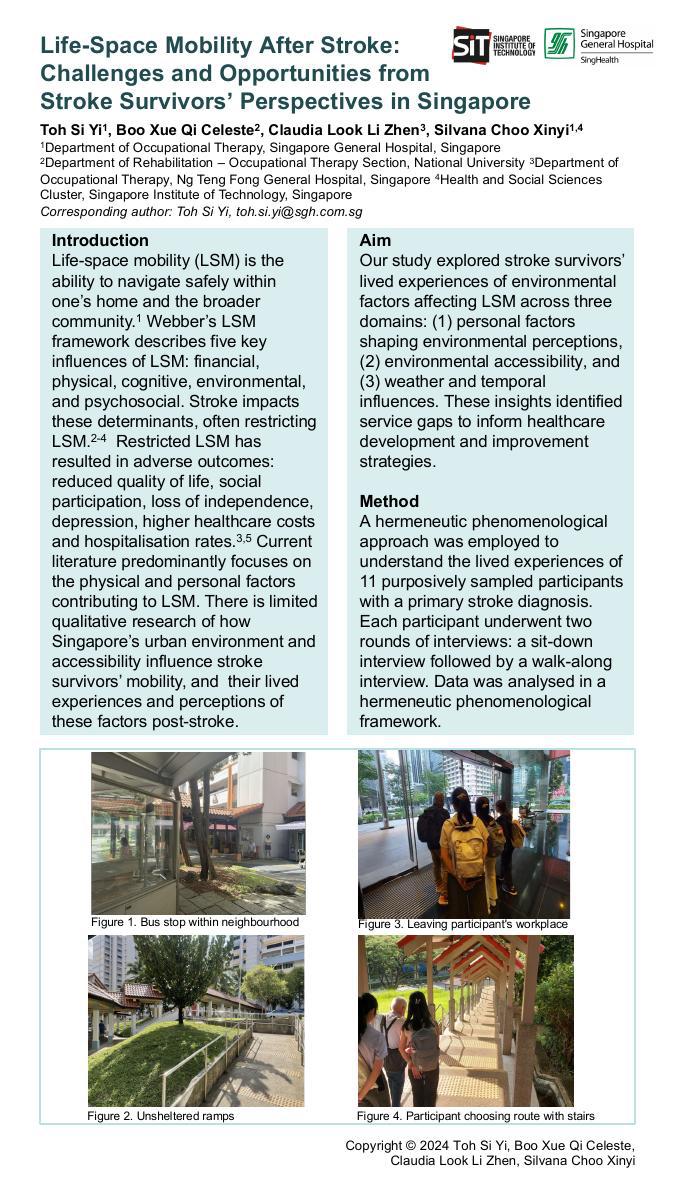
Introduction: Life-space mobility (LSM), the ability to move within and across one’s home to the wider community, is restricted after a stroke. Environmental factor, a key determinant of LSM, has not been sufficiently studied. Understanding the influence of environment on stroke survivors’ LSM can provide feedback for refining current clinical practices to enhance LSM, thereby improving their quality of life.
Objectives: This study explored how environmental factors, including the built environment, social context, and transportation, influenced stroke survivors’ LSM in Singapore.
Methods: We conducted semi-structured sit-down and go-along interviews with 11 community-dwelling stroke survivors, purposively sampled based on sex and duration post-stroke. Sit-down interviews explored participants’ experiences, while go-along interviews captured real-time insights on LSM during community outings. Data was analysed using thematic analysis within a hermeneutic phenomenological framework.
Results: Three broad themes emerged: environmental influences, adaptation, and empowerment. Stroke survivors' LSM was shaped by environmental factors, including the accessibility of public transport, availability of social support, and the built environment. Adaptation to environmental barriers (e.g., weather, infrastructure) required survivors to modify their routines. Gradually, behaviours shifted from avoidance to empowerment in navigating their environment. Findings highlight the importance of OT interventions that improve environmental accessibility and support survivors' ongoing adaptation, thereby enhancing their LSM.
Conclusion: Our study emphasises the significant role of environmental factors in optimising LSM for stroke survivors. While personal factors, such as intrinsic motivation, also contribute, OT interventions can focus on environmental modifications and fostering adaptive behaviours. A comprehensive, client-centred approach is essential for enhancing autonomy, participation, and LSM after stroke.