
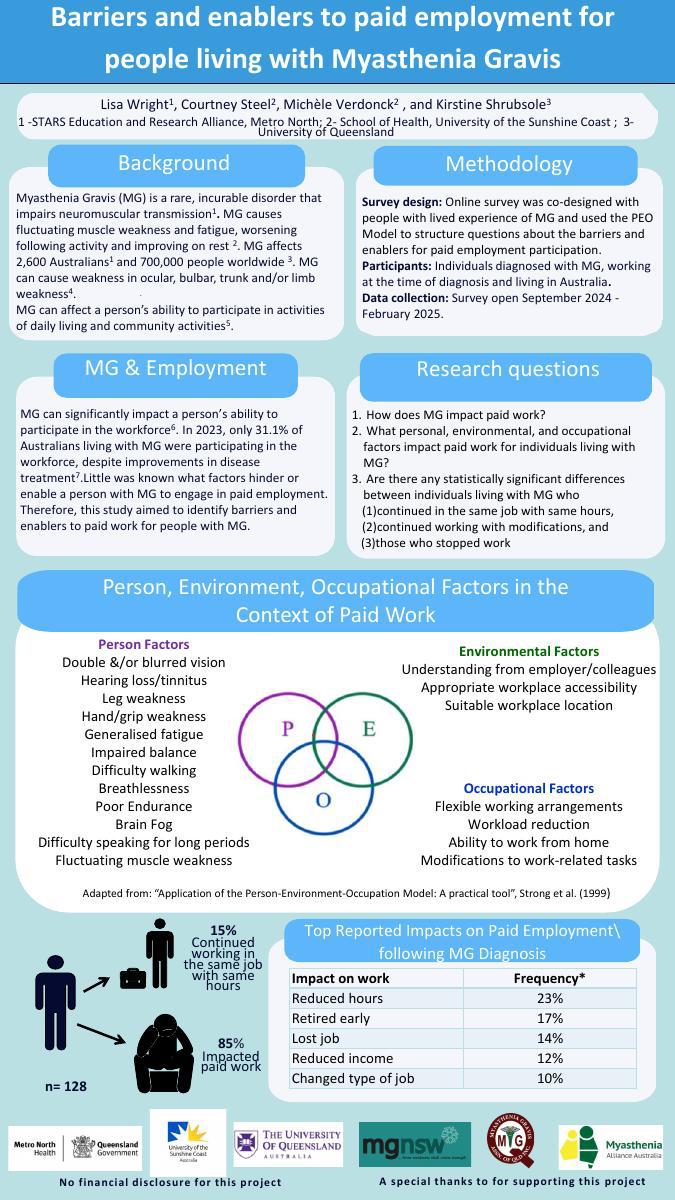
Introduction: Myasthenia Gravis (MG) is a chronic neuromuscular disease characterised by fluctuating muscle weakness and fatigue, which worsens following activity and improves with rest. Despite advances in treatment, the employment rate for this population has not improved, with only 31.1% of individuals still working post-diagnosis. There has been no research exploring the barriers and enablers of people with MG to participate in paid employment and a limited understanding of how to support people with MG to maintain and/ or return to paid employment.
Objectives: To explore the barriers and enablers influencing participation in paid employment for people with MG.
Method: An anonymous online survey was co-designed with people with lived experience of MG and used the Occupational Therapy Person-Environment-Occupation (PEO) Model to structure questions about the barriers and enablers for paid employment participation.
Results: A total of 142 participants with MG completed the survey. Results indicate that MG significantly impacts people's ability to maintain employment, with 61% (n=79) discontinuing work due to MG and only 15% (n=19) continuing in the same job. Key barriers identified by participants for maintaining work included fluctuating muscle weakness (70%, n=87) and need for frequent rest breaks (58%, n=72). Flexible working arrangements and work-related task modifications were identified as key enablers for paid work participation.
Significance for OT Profession: This research highlights the person, occupational and environmental factors that can either enable or hinder participation in paid work for people with MG. This knowledge is invaluable for occupational therapists supporting people with MG to maintain and/or return to paid employment.