
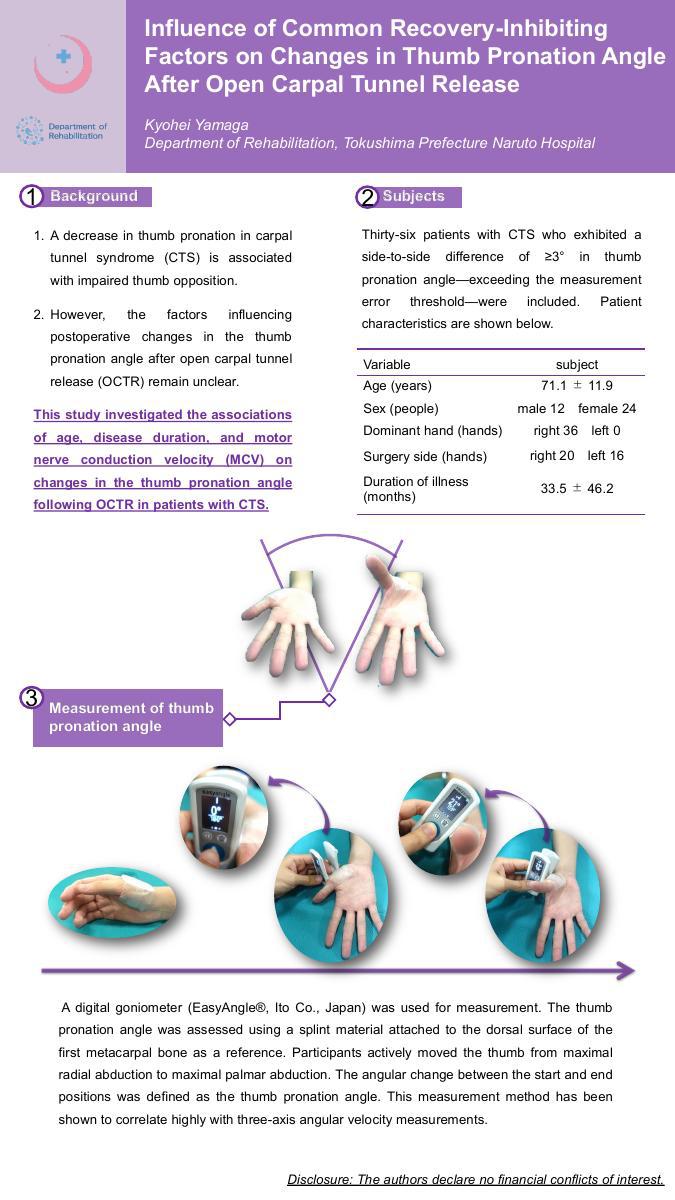
Introduction: A decrease in the thumb pronation angle in carpal tunnel syndrome (CTS) is associated with impaired pronation function. However, the factors influencing changes in this angle after open carpal tunnel release (OCTR) remain unclear.
Objective: This study investigated the effects of age, disease duration, and motor nerve conduction velocity (MCV) on changes in the thumb pronation angle following OCTR in patients with CTS.
Methods: Thirty-six patients with CTS who exhibited a side-to-side difference of ≥3° in the thumb pronation angle, exceeding the measurement error threshold, were included. All patients underwent thenar muscle strengthening exercises after OCTR. A digital goniometer was used to measure the thumb pronation angle on the affected side preoperatively and six months postoperatively. An improvement of ≥3° was set as the dependent variable. Age, disease duration, and MCV were analyzed as independent variables to assess their association with postoperative improvement. This study was approved by the institutional ethics committee (Approval No. 1331).
Results: At six months postoperatively, 19 patients showed improvement in the thumb pronation angle, while 17 did not. No significant associations were found between the independent variables and postoperative improvement.
Conclusion: The findings suggest that commonly recognized recovery-inhibiting factors, such as age, disease duration, and MCV, do not significantly affect changes in the thumb pronation angle after OCTR. These results indicate that even in cases with generally poor prognostic conditions, postoperative improvement in the thumb pronation angle remains possible.