
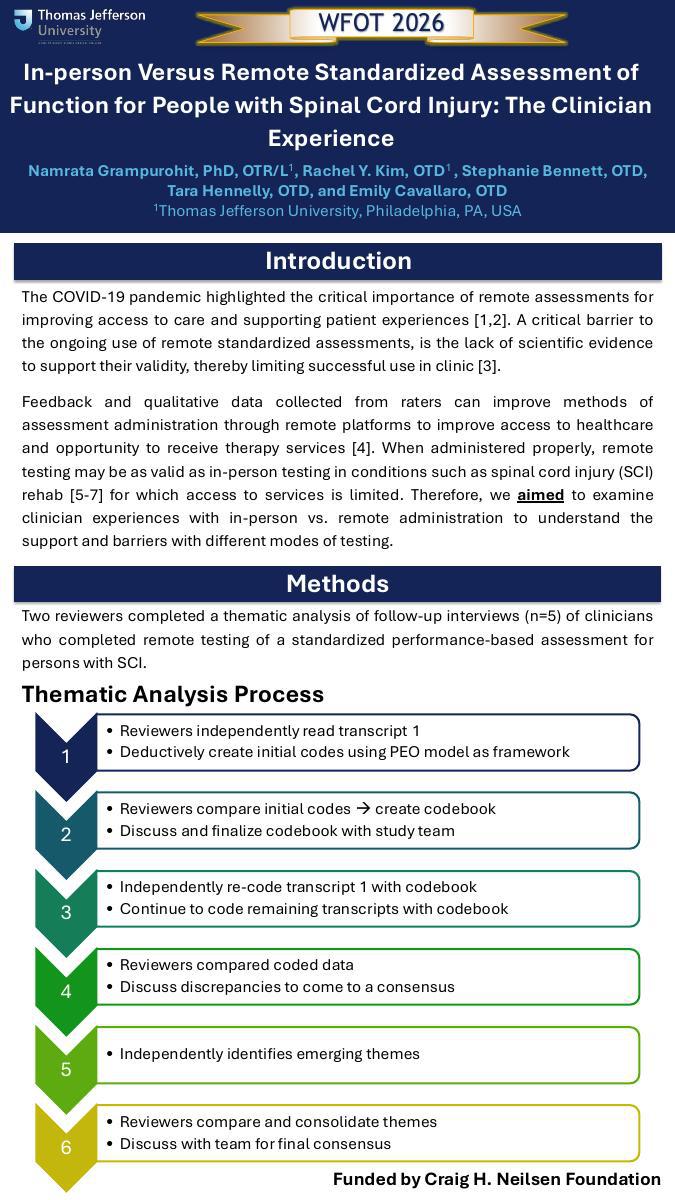
Introduction / Rationale: The COVID-19 pandemic highlighted the critical importance of remote assessments for improving access to care and supporting patient experiences. When administered properly, remote testing may be as reliable and valid as in-person testing. Therefore, it is important to examine clinician experiences with in-person versus remote administration to understand the support and barriers with different modes of testing.
Objectives:
- To examine clinician experiences with in-person versus remote administration of spinal cord injury (SCI) function assessments.
- To identify benefits, barriers, and necessary supports for remote administration.
Methods / Approach: Qualitative methodology included a thematic analysis of follow-up interviews with five clinicians: three occupational therapists, one physical therapist, and one occupational therapy student. All interviews were audio-recorded and transcribed verbatim. Two reviewers independently and deductively coded the data using the Person-Environment-Occupation Model and subsequently inductively coded the data to identify emerging themes. Reviewers examined each other’s themes and obtained consensus with periodic research team review.
Results / Practice Implications: Three themes emerged: (1) acceptability, (2) feasibility, and (3) access. Clinicians reported increased access to care with remote testing and high acceptability and feasibility despite some barriers. Recommendations to enhance the remote testing experience related to assessment organization, training, and additional support materials.
Conclusion / Contribution to the occupational therapy profession: Remote assessment administration provides a feasible solution for overcoming barriers to accessing occupational therapy services. Clinician perspectives on remote versus in-person administration experiences provide valuable insight to improve and sustain quality remote therapeutic services.