
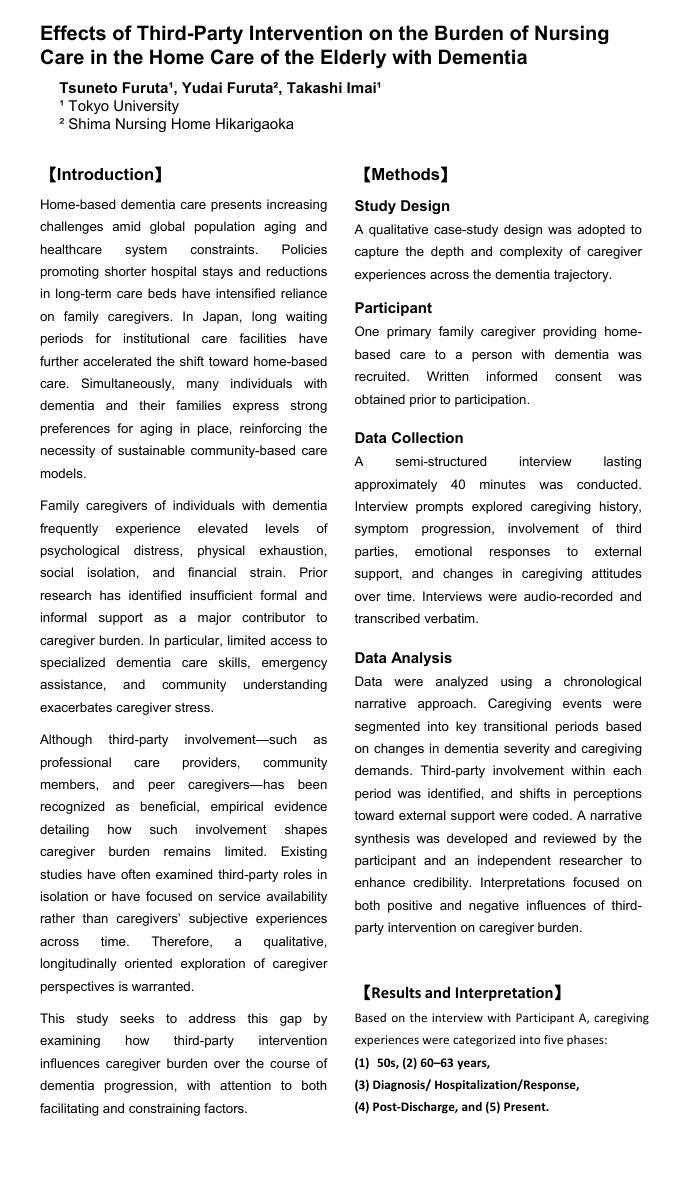
[Introduction] Many studies have been conducted on the relationship between dementia care and a third party, such as Takeo finding that people around him can lead a peaceful life through understanding and consideration, and Hisamatsu's finding that the situation improved after professional intervention. However, there are few studies on the pros and cons of a third party from the caregiver's perspective.
[Purpose] In this study, we interviewed home dementia caregivers and examined the effects of third-party intervention on their caregiving burden.
[Methods] We conducted semi-structured interviews with home dementia caregivers who agreed to participate in this study. In the analysis method, events were separated by turning points according to the progression of dementia symptoms, and attitudes toward third parties were extracted.
[Results and Interpretation] Four transition periods were observed: the predictive period, the final diagnosis period, the readjustment period, and the continuation period.
In the predictive period, family members living together were less likely to notice the change, while family members separated from the family members noticed the change, but they respected the statements of the parties involved.
In the definite diagnosis period, the caregivers were seeking advice from specialists and procedures for services in order to live at home after discharge. In the readjustment period, the caregivers were seeking information from local residents, procedures for adult guardians, and support from specialists such as care managers. In the continuous life period, the caregivers were paying attention to their own health and reducing their burden in order to continue a stable life.
[Conclusion] For caregivers, understanding of the dementia of a third person is a condition that makes it easier to ask for cooperation.