
Introduction / Rationale: The CO-OP intervention is a client-centered intervention that aims to improve the patient's ability to perform daily life activities by teaching problem-solving strategies, and is also an intervention based on occupational performance. Domestic and foreign studies have reported that the quality of daily life activities and occupational performance has improved through the CO-OP intervention, and various positive results have been reported, such as improved motor function.
Objectives: This study aimed to investigate the effectiveness of the Cognitive Orientation to Daily Occupational Performance (CO-OP) intervention on the occupational performance and activities of daily living of stroke patients.
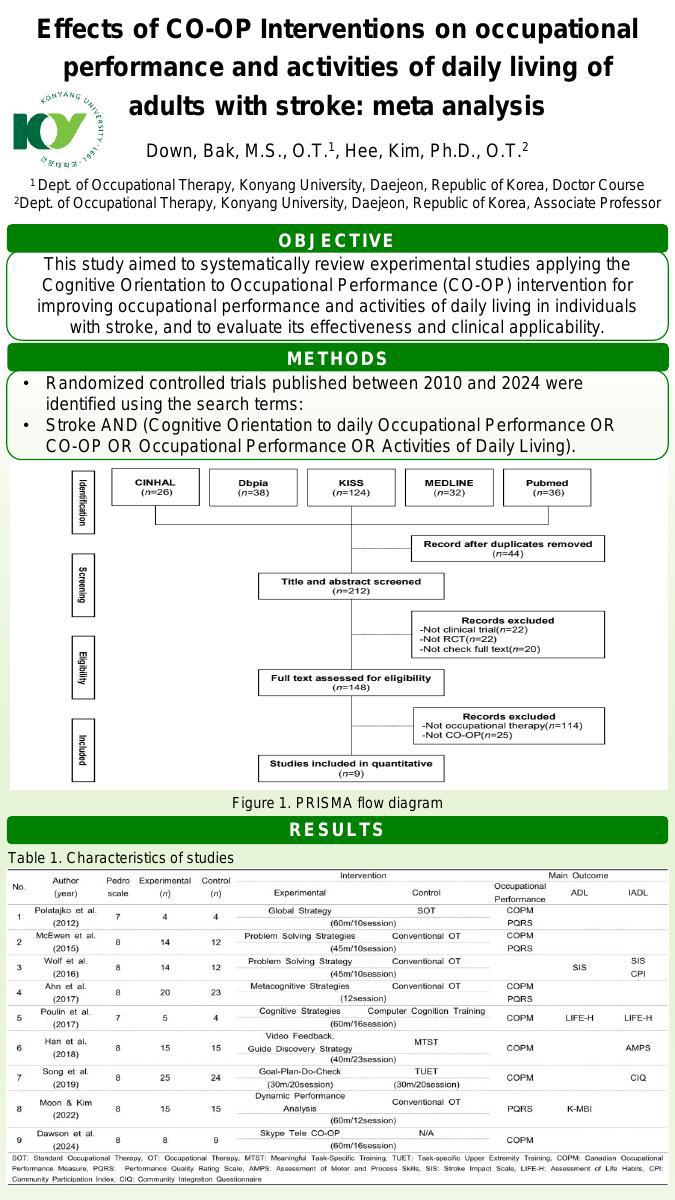
Methods / Approach: A meta-analysis was conducted of domestic and international randomized controlled trials that verified the effectiveness of cognitive-based occupational performance interventions for stroke patients, published between January 2010 and January 2024. CINAHL, MEDLINE, PubMed, Dbpia, RISS, and Scholar were used as academic databases for searching. The quality of selected studies was assessed using the PEDro scale, and systematically organized using Patient, Intervention, Comparison, and Outcome (PICO). Meta-analysis was performed using R 4.2.1 to test effect size, statistical heterogeneity, and publication error.
Results / Practice Implications: The quality of the nine selected papers was the highest as they were all randomized trials. The meta-analysis results showed that both occupational performance and activities of daily living had a medium effect size of 0.82, which was statistically significant.
Conclusion / Contribution to the occupational therapy profession: Occupational therapy using CO-OP for stroke patients has been shown to improve patients’ occupational performance and enhance activities of daily living. It is expected that CO-OP intervention will be utilized for the rehabilitation of stroke patients in clinical settings.