
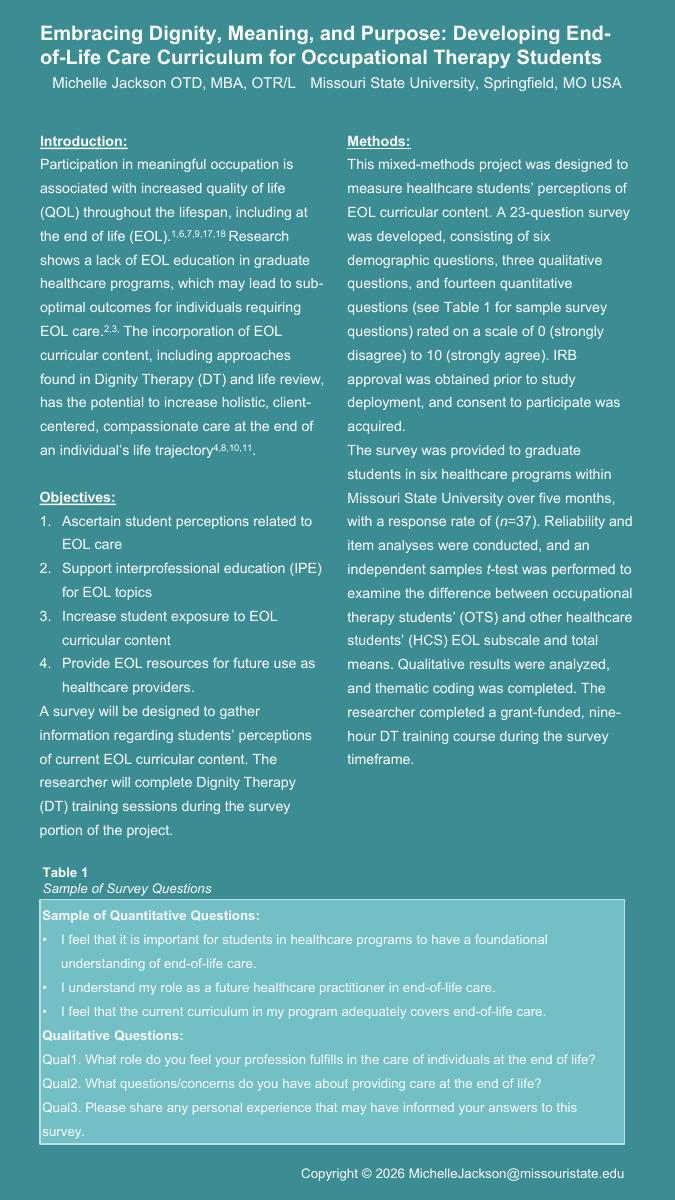
Introduction / Rationale: Participation in meaningful occupation is associated with increased quality of life (QOL) throughout the lifespan; however, research shows a lack of end-of-life (EOL) education in graduate healthcare programs.
Objectives: A survey will be used to gather information related to student perceptions of current curricular content related to EOL care. The results of the survey, in concert with knowledge gained from Dignity Therapy (DT) training, will guide the development of an interprofessional instructional module.
Methods / Approach: A 23-question survey designed to measure perceptions of curricular content related to EOL concepts was provided to graduate students in six healthcare programs over five months, with a response rate of (n=39). Reliability and item analyses were performed, and an independent samples t test was performed to examine differences between OTS and other healthcare students (HCS). DT training was completed Fall 2024.
Results / Practice Implications: Analyses determined no significant difference in subscale scores between OTS and other HCS. For OTS, results were: adequacy (M=4.25; range 0-10); perceived knowledge (M= 6.25; range 0-20); confidence/competence (M=10.5; range 0-20); comfort (M=19; range 0-30); personal importance (M=36.5; range 0-40). Results reflecting lower levels of adequacy and perceived knowledge along with moderate levels of confidence/competence support the need for EOL curricular content for OTS.
Conclusion / Significance to the Occupational Therapy Profession:
EOL education is needed to address knowledge, confidence, and competence related to occupation-based, culturally sensitive, client-centered interventions. Such curricular content can equip future OT practitioners to design interventions that provide a sense of purpose and dignity in the final stage of life.