
Introduction: Occupational therapists address the needs of autistic individuals across the lifespan to support client-centered occupational engagement. This poster presentation is based on a broader dissertation study about community social participation experiences of autistic young adults in the southern United States and will focus on findings related to the role of the environment. This study highlighted autistic young adult voices and supported first-person perspectives to gain a better understanding of well-being and social participation (Lam et al., 2021). Note: Identity-first language is mixed with person-first language to reflect the preference expressed by the autistic community of identity-first language (Bottema- Beutel et al., 2021).
Objectives:
1. Understand the findings of a qualitative multiple-case study about the role of the environment in community social participation experiences of autistic young adults.
2. Discuss the implications of this study to occupational therapy practice and programming for autistic young adults.
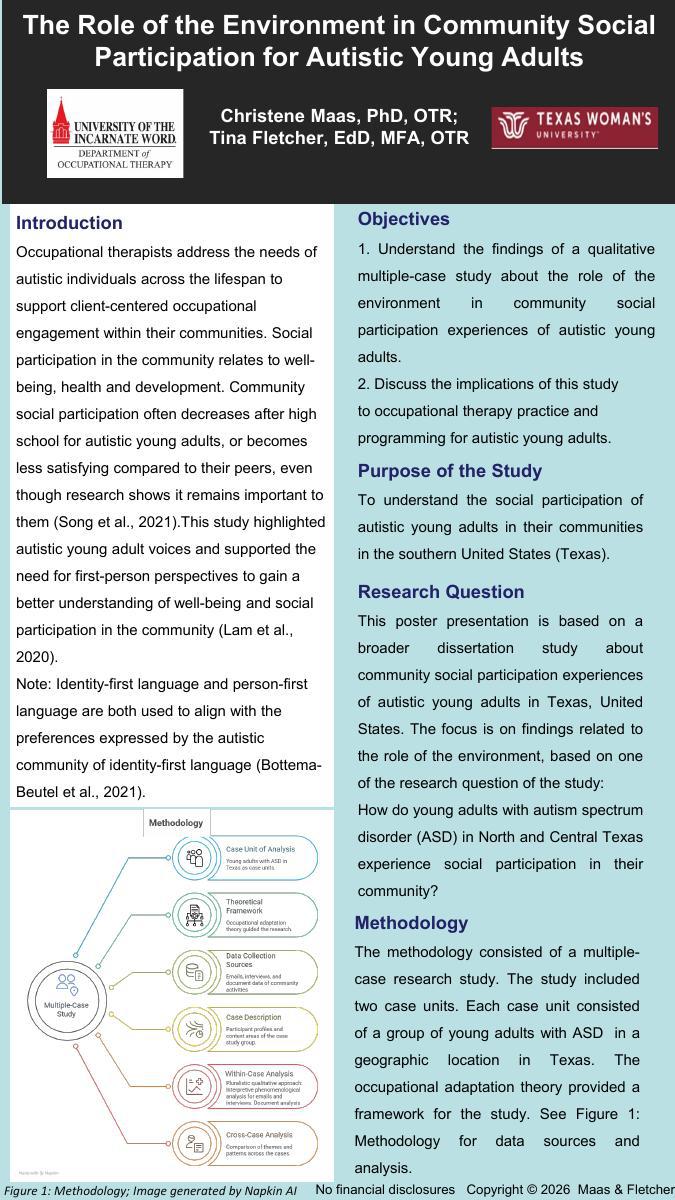
Methods: The methodology consisted of a qualitative multiple-case study and used the theoretical framework of occupational adaptation theory. Data sources included emails, interviews, and documents of community events. Findings from within-case and cross-case analysis will be shared.
Practice Implications: Understanding perspectives of autistic young adults and how the environment can be a facilitator or barrier, OTPs can plan interventions and programming that are authentic and support participation in the community.
Conclusion: The discussion will highlight environment facilitators and barriers. It will also describe positive experiences for autistic young adults that may differ from neurotypical young adult positive experiences in the community (Lam et al., 2021). Aligned with the conference theme, the findings and discussion can inspire change in approaches in supporting autistic young adult community participation.