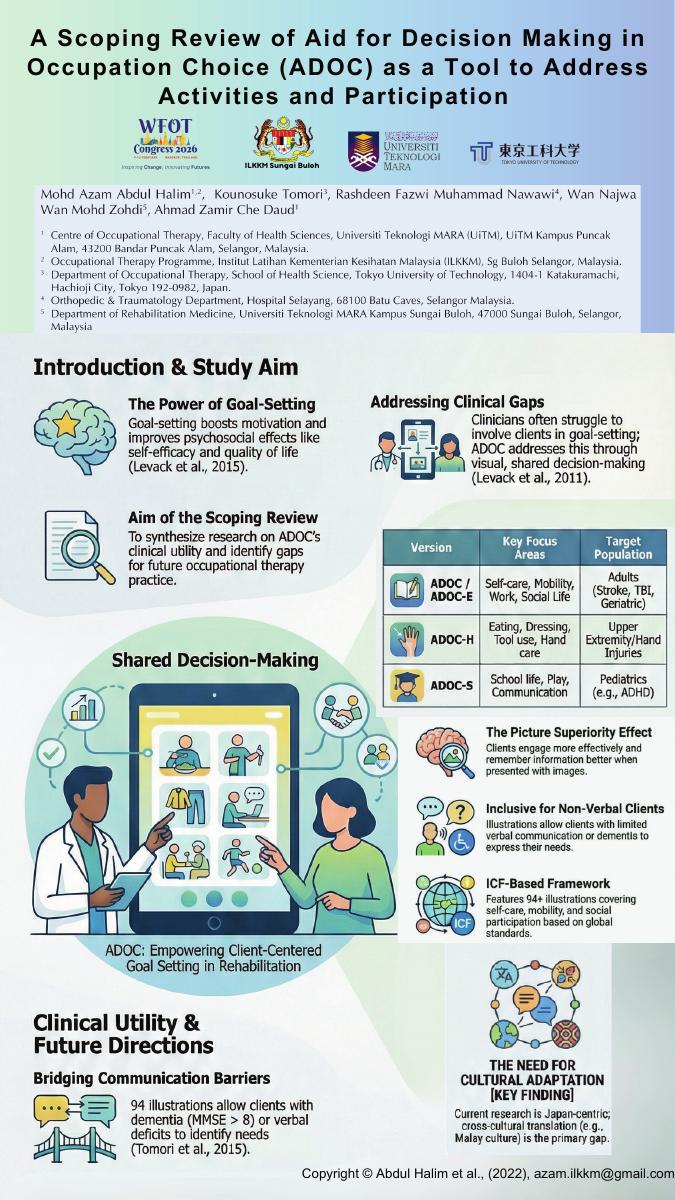
Introduction / Rationale: Aid for Decision-Making in Occupation Choice (ADOC) was developed to encourage shared decision-making and collaborative goal-setting in daily living activities. To our best knowledge and reading, this is the first study that reviewed and discussed about the use of ADOC in occupational therapy practice. Objectives: This scoping review aimed to review and synthesize research literature regarding ADOC and to identify any existing knowledge gap related to ADOC. Methods / Approach: The PRISMA-Scoping review was used as a guideline. A literature search was retrieved from January 2011 until December 2021 based on four databases; Scopus, Google Scholar, PubMed and CINAHL based on inclusion and exclusion criteria. Results / Practice Implications: A total of nine articles (N=9) were included in this review. The findings were arranged in five themes; i) clinical purpose, ii) validity and reliability, iii) target population, iv) utility of ADOC and v) domains and items of ADOC. Six articles in the evaluated literature utilised mixed methodologies, one study used the quantitative approach (experimental) and two articles employed the qualitative method. Conclusion / Contribution to the occupational therapy profession: Interestingly, ADOC can be used in different conditions and settings and is also applicable in paper printed versions. ADOC is superior to other client-centred assessment tools because it can recognize occupational needs through images and illustrations even for clients lacking verbal communication. ADOC provides a client-centred and collaborative approach, highlighting meaningful occupations in daily living and the use of technology in rehabilitation. ADOC is one of the beneficial tools to practitioners and assists clients in decision making to address their occupational performance problems.
