
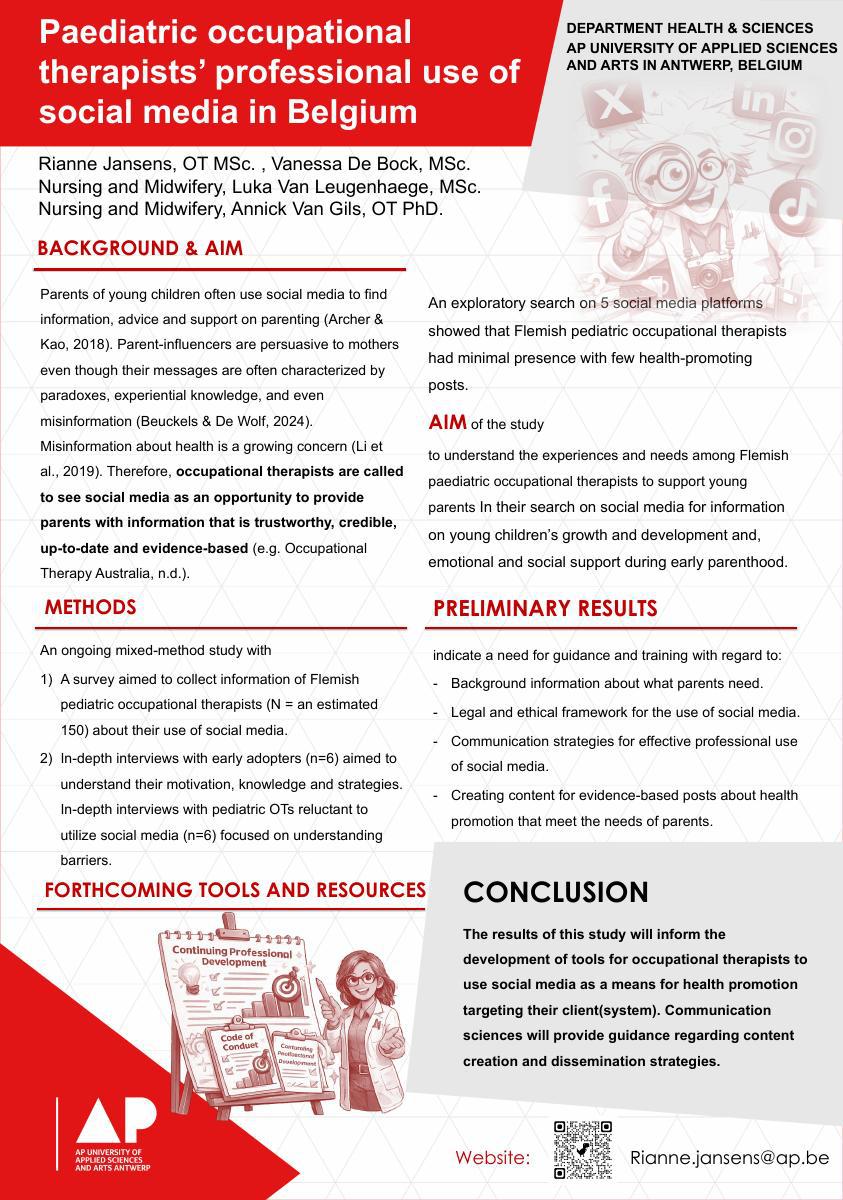
Introduction: Parents of young children often use social media to find information, advice and support on parenting (Archer & Kao, 2018). Parent-influencers are persuasive to mothers even though their messages are often characterized by paradoxes, experiential knowledge, and misinformation (Beuckels & De Wolf, 2024). Misinformation about health is a growing concern (Li et al., 2019). Therefore, occupational therapists are called to see social media as an opportunity to provide parents with information that is trustworthy, credible, up-to-date and evidence-based (Occupational Therapy Australia, n.d.). An exploratory search on 5 social media platforms showed that Flemish pediatric occupational therapists had minimal presence with few health-promoting posts.
Method: The objective is to understand the experiences and needs among Flemish pediatric occupational therapists to support young parents in their search for information and emotional and social support about their child’s development via social media. Therefore, a mixed-method study was designed. A survey aimed to collect information of Flemish pediatric occupational therapists (N = an estimated 150) about their use of social media. In depth-interviews with early adopters (n=6) aimed to understand motivation, the required knowledge and strategies for using social media for health promotion. Interviews with occupational therapists reluctant regarding social media (n=6) focused on understanding barriers. The study conducted in spring 2025 will be analyzed through content analysis (Krippendorff, 2018).
Results/Contribution to the occupational therapy profession: The results will inform the development of tools for occupational therapists to use social media as a means for health promotion targeting their client(system). Communication sciences will provide guidance regarding content creation and dissemination strategies.