
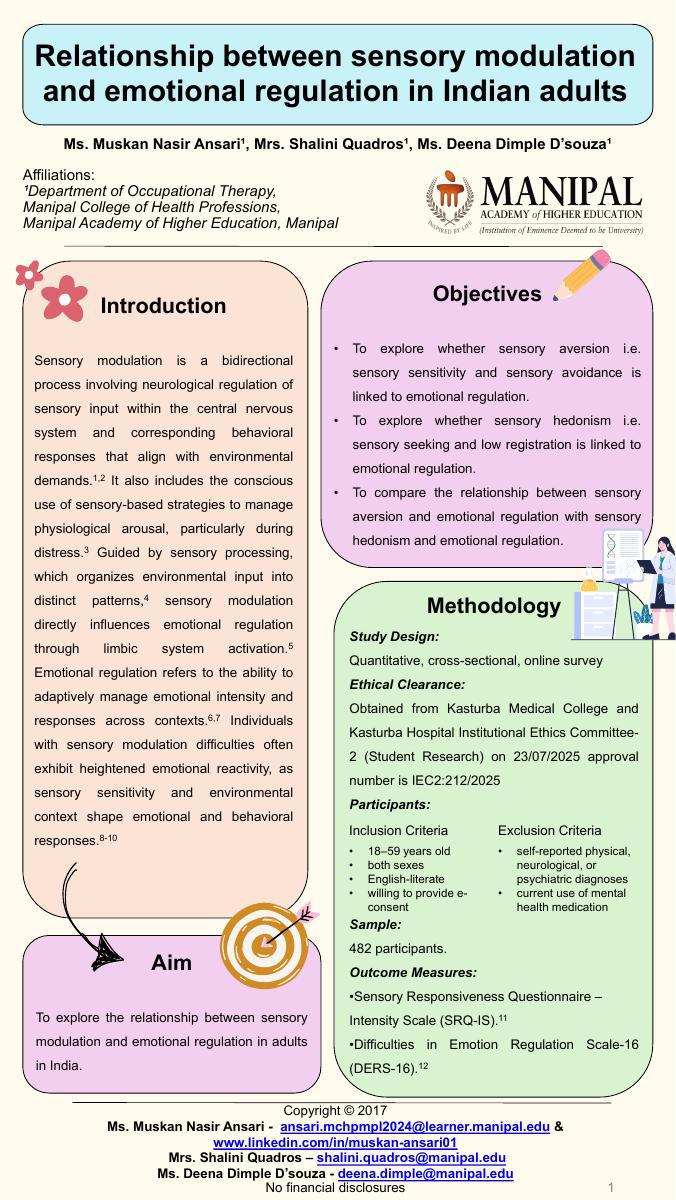
Introduction / Rationale: Growing research on children, adolescents and adults with mental health disorders worldwide has found a relationship between sensory modulation and emotional regulation. However, these studies primarily only focus on relationship between sensory sensitivity and emotional regulation. Investigating all four domains of sensory modulation (i.e. sensory sensitivity, sensory avoiding, sensory seeking and low registration) ensures a more holistic understanding of sensory-emotional connection in typical adults.
Objectives: To find the relationship between all the four domains of sensory modulation patterns and emotional regulation in typical Indian adults.
Methods / Approach: 482 typical adults aged 18-59 years will complete the Sensory Responsiveness Questionnaire and Difficulties in Emotion Regulation Scale -16 via an online survey. The obtained data will be analysed to find the relationship between sensory modulation and emotional regulation.
Results / Practice Implications: This study will provide contextually relevant evidence for the use of sensory modulation interventions for emotional regulation in India and can help in maintaining or improving emotional wellbeing or; prevent development of or early identification of mental health disorders.
Conclusion / Significance to the Occupational Therapy profession: By exploring all four domains of sensory modulation, this study seeks to provide a more detailed understanding of the sensory modulation and emotional regulation relationship, so that occupational therapists can implement sensory modulation-based strategies to improve emotional regulation, stress management and preventing symptom exacerbation in at-risk adults, thereby promoting mental health and well-being.