
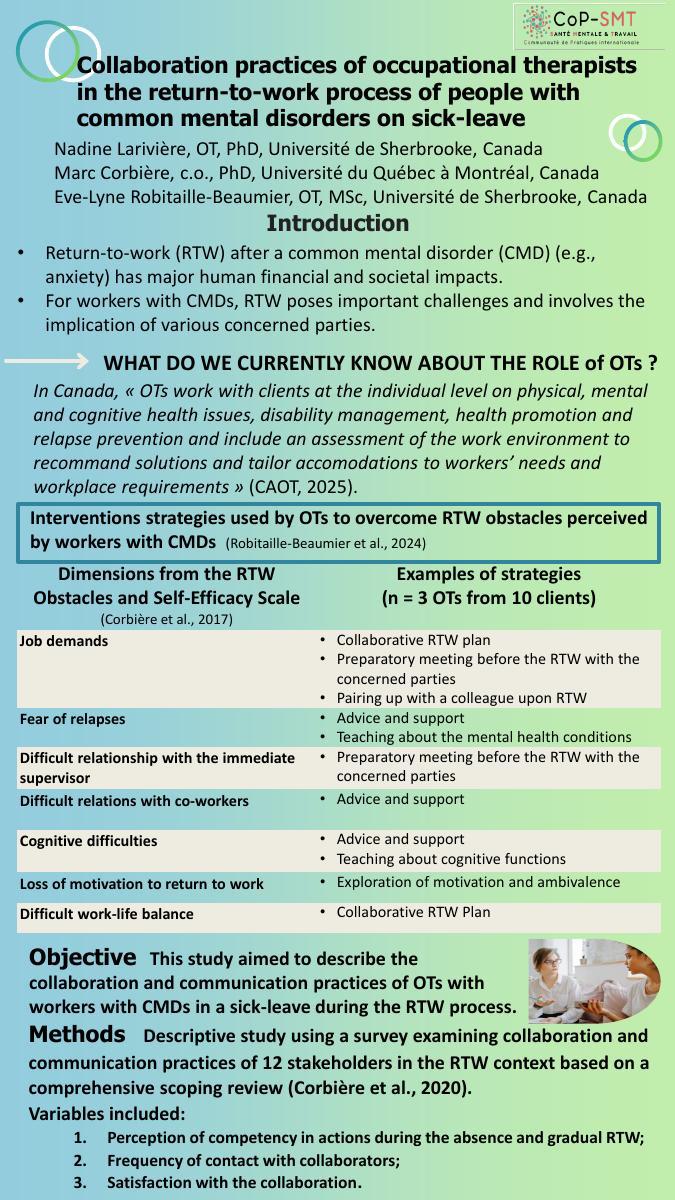
Introduction: Occupational therapists play a key role in the return-to-work (RTW) process of people with common mental disorders, working with various collaborators from the health, employer and insurance systems. Little is known on their perception of competence and satisfaction in their communication and collaborative actions in all phases of return-to-work of workers on sick-leave.
Objectives: This study aimed to describe the collaboration and communication practices of occupational therapists with people common mental disorders in a sick-leave during the RTW process.
Methods: This descriptive study is based on an international survey examining collaboration and communication practices of twelve stakeholders in the return-to-work context. The variables include perception of competency in actions during the absence, and gradual RTW, frequency of contact with collaborators and satisfaction with the collaboration.
Results: Preliminary analysis with 53 Canadian occupational therapists shows that the participants list 33 collaborative actions during the RTW process. Over 90% feel highly competent when the relational and evaluative tasks, in all phases, concern the worker. They report feeling somewhat less competent when the tasks involve team management actions with the other stakeholders (e.g., allocate tasks between professionals). They have contacts with all twelve stakeholders but mainly the workers, general physicians, psychotherapists, human resources, managers and insurance agents. They are highly satisfied with their collaboration with these six stakeholders to support RTW (overall mean of 5,52/6).
Conclusion: Occupational therapists value and display collaborative practices with stakeholders from different systems. They report high perceived competence when their actions involve communication and assessment of workers with common mental disorders.