
Introduction / Rationale: A diverse occupational therapy (OT) workforce is crucial for addressing health disparities and enhancing client outcomes. However, traditional OT programs' admissions processes often fail to equitably recruit underrepresented minority (URM) students. In the United States (U.S.), URMs remain significantly underrepresented in OT programs and the workforce, demonstrating the need for intentional diverse strategies. To address this barrier, Hawaii Pacific University’s Doctor of Occupational Therapy (HPU OTD) program successfully implemented competency-based assessment and holistic admissions. As a result, URM representation in the program significantly surpassed U.S. averages in OT education.
Objectives: To enhance equitable admissions processes by mitigating bias, assessing key personal traits, and leveraging data to refine recruitment strategies.
Methods / Approach: The HPU OTD program utilized a holistic admissions framework incorporating the American Occupational Therapy Association’s (AOTA’s) defined soft-skills, transparent rubrics, and multi-reviewer evaluations to ensure fair program admissions applicant selection. Cohort demographics were analyzed against U.S national benchmarks to measure progress and refine recruitment strategies.
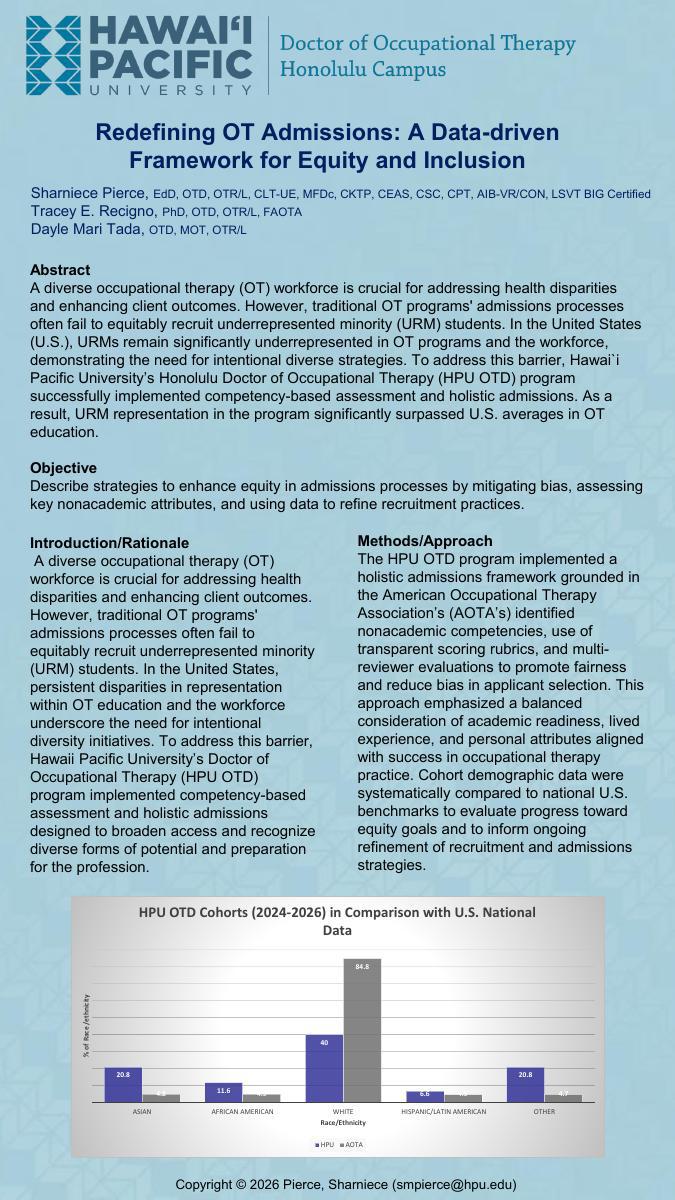
Results / Practice Implications: Compared to AOTA’s workforce data, HPU’s 2025 and 2026 cohorts demonstrated increased diversity: 31% White, 13% Asian, 7% Black, 5% Native Hawaiian/Pacific Islander, 4% Hispanic, and 12% identifying as more than one race. URM enrollment at HPU exceeds national OT workforce averages, supporting the effectiveness of holistic admissions. This framework fosters equity by mitigating bias and enhancing the selection process.
Conclusion / Contribution to the occupational therapy profession: Competency-based admissions and bias mitigation create an equitable and representative OT workforce. This scalable model can be applied globally to support diversity in the OT profession.