
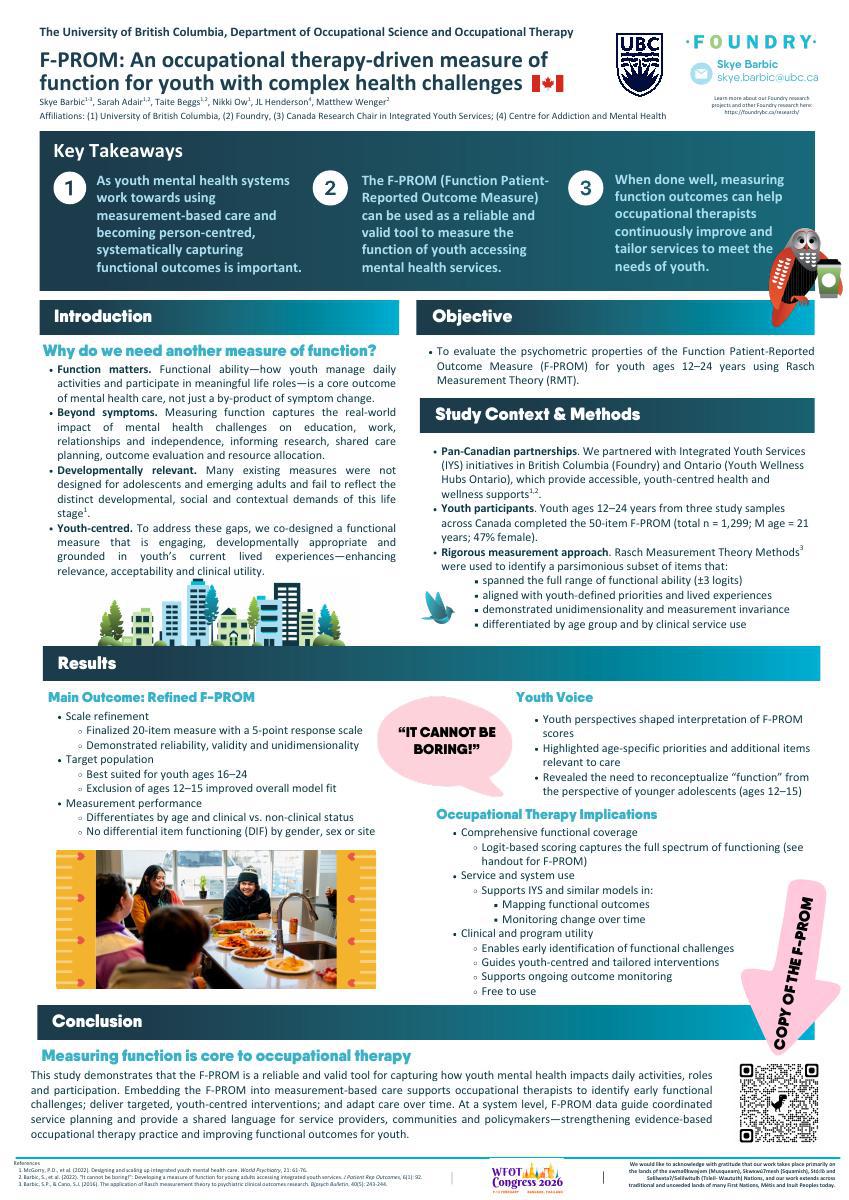
Introduction / Rationale: Youth with complex health and social challenges often struggle to achieve optimal functional outcomes. Existing assessment tools do not fully address the unique needs of this group. The Functional Patient Reported Outcome Measure (FPROM) was developed to fill this gap, providing a youth-centered tool to assess functional participation across various life domains.
Objectives: This study aimed to (1) develop FPROM, a new measure of function for youth that assesses participation and role occupation across key domains, and (2) evaluate its reliability, validity, and practical application.
Methods / Approach: FPROM was developed through a collaborative process involving youth, healthcare providers, and occupational therapists. The measure was tested with a sample of 950 youth participants (ages 12-24) using a combination of self-reports. Using traditional and Rasch analyses, data were analyzed for reliability, construct and structural validity, and responsiveness to change over time.
Results / Practice Implications: The 30-item FPROM was found to be reliable (rp=0.93) and valid (Rasch model X2=390.1, p<0.001). The measure demonstrated significant differences between clinical and non-clinical youth (F=3.65, p<0.05). FPROM also showed strong correlations with other functional ability measures and captured a broad range of barriers to daily participation.
Conclusion / Contribution to the Occupational Therapy Profession: The FPROM contributes significantly to the field of occupational therapy by offering a specialized tool to assess the unique functional needs of youth. This tool enables therapists to provide more accurate, effective interventions, enhancing the role of occupational therapy in promoting participation and improving life outcomes for youth.