
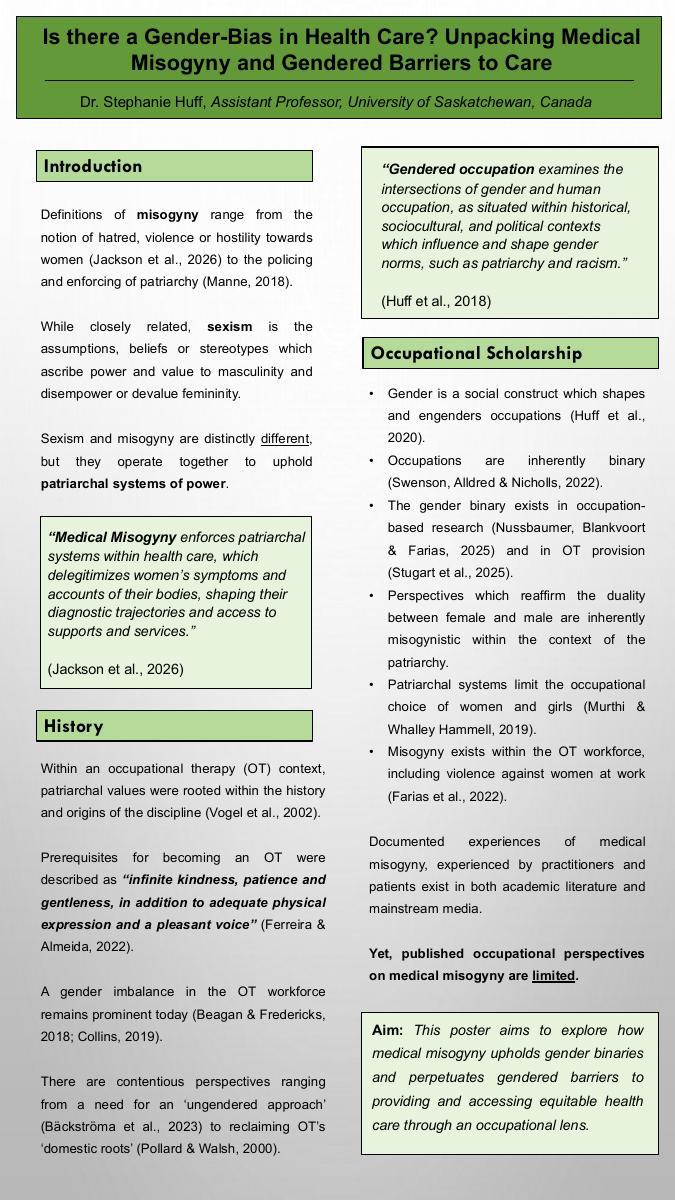
Introduction: Existing scholarship on gendered occupation suggests sociocultural and political constructs of gender must be unpacked to challenge systems of power which perpetuate gender inequities, such as barriers to accessing equitable health care.
Objectives: This paper aims to: 1) build upon existing occupation-based scholarship on gendered occupation and occupational justice to unpack medical misogyny from an occupational lens, 2) explore how misogyny upholds gender binaries and shapes gendered barriers to equitable health care, and 3) spark dialogue on transformative approaches to gender affirming care.
Approach: The lived experiences of autistic women seeking a late-life diagnosis are considered to highlight gendered barriers within existing diagnostic pathways. Intersectional and critical feminist theoretical lenses underpin this conceptual paper to demonstrate how some individuals and groups disproportionately experience access barriers rooted in gender. Subsequent commentary on gender affirming care calls for transformative approaches which deconstruct gendered binaries and barriers to equitable healthcare.
Practice Implications: The population discussed in this paper is one example of a marginalized group experiencing access barriers rooted in constructions of gender. Irrespective of gender identity, medical misogyny disproportionately shapes access barriers to equitable health care for the LGBTQ+ community, people with disabilities and chronic illness, and people of color.
Significance to the Occupational Therapy profession: Occupational Therapists must advocate for health equity for all, which requires acknowledging and challenging systems of power which disproprtionately shape access barriers for some individuals and groups. Transformative approaches to care which deconstruct gender barriers and are affirming of gender identity are necessary to promote occupational justice for all.