
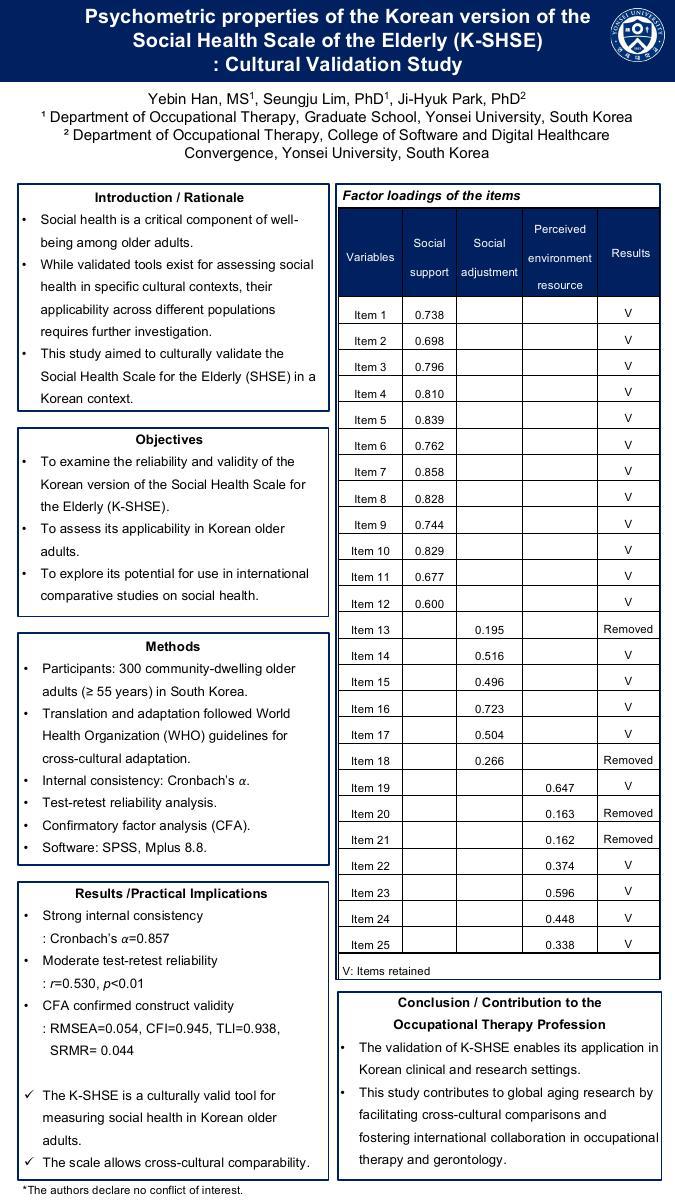
Introduction / Rationale: Social health is a critical component of well-being among older adults. While validated tools exist for assessing social health in specific cultural contexts, their applicability across different populations requires further investigation. This study aimed to culturally validate the Social Health Scale for the Elderly (SHSE) in a Korean context, ensuring its relevance for both national use and potential cross-cultural research.
Objectives: To examine the reliability and validity of the Korean version of the Social Health Scale for the Elderly (K-SHSE) and assess its applicability in Korean older adults. Additionally, to explore its potential for use in international comparative studies on social health.
Methods / Approach: A survey was conducted with 300 community-dwelling older adults (≥ 55 years) in South Korea. The translation and adaptation followed World Health Organization (WHO) guidelines for cross-cultural adaptation. Internal consistency was assessed using Cronbach’s alpha, and test-retest reliability was analyzed. Confirmatory factor analysis (CFA) was conducted with SPSS and Mplus 8.8.
Results / Practice Implications: The K-SHSE demonstrated strong internal consistency (Cronbach’s alpha = 0.857) and moderate test-retest reliability (r = 0.530, p < 0.01). CFA confirmed construct validity (RMSEA = 0.054, CFI = 0.945, TLI = 0.938, SRMR = 0.044). These findings suggest that K-SHSE is a culturally valid tool for measuring social health in Korean older adults while allowing cross-cultural comparability.
Conclusion / Contribution to the Occupational Therapy Profession: The validation of K-SHSE enables its application in Korean clinical and research settings, supporting targeted interventions to enhance social health. This study contributes to global aging research by facilitating cross-cultural comparisons and fostering international collaboration in occupational therapy and gerontology.