
Introduction / Rationale: Lifestyle is integral to overall health, including physical, psychosocial, and social well-being. While prior research has examined its effects on physical and mental health, its influence on social health remains unclear. This study investigates the structural relationship between lifestyle and social health in Korean older adults.
Objectives: To determine how lifestyle factors influence social health, specifically social support, social adaptation, and perceived environmental resources, using structural equation modeling.
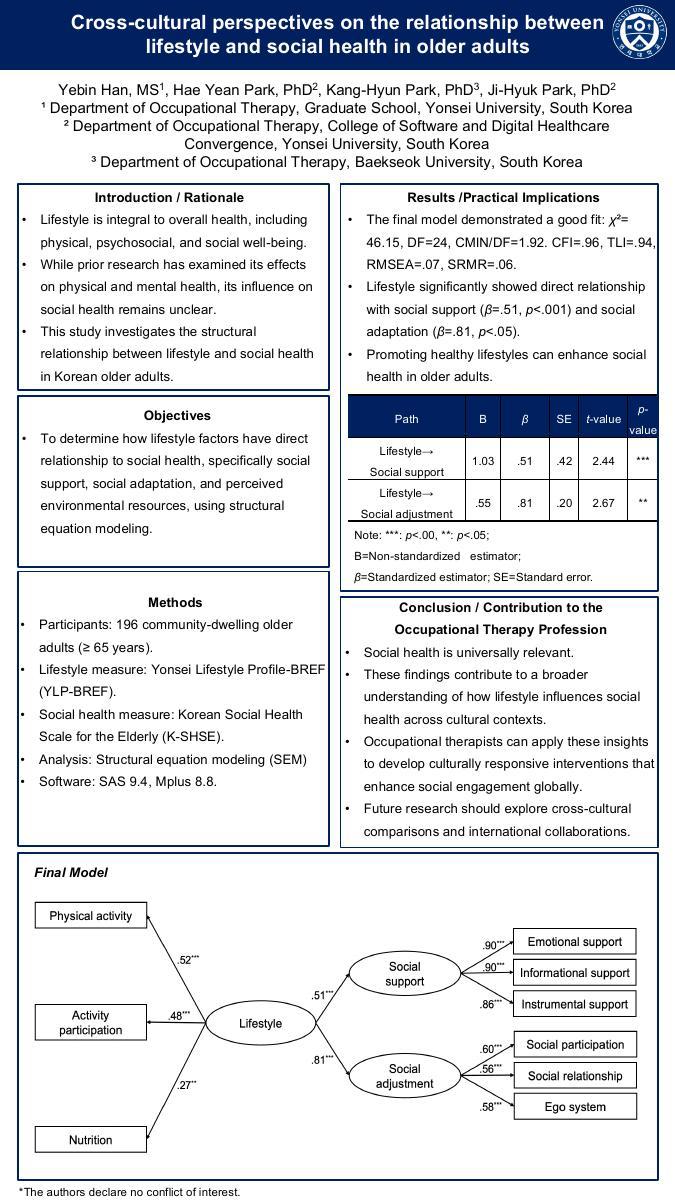
Methods / Approach: A survey was conducted with 196 community-dwelling older adults (≥ 65 years). Lifestyle patterns were assessed using the Yonsei Lifestyle Profile-BREF (YLP-BREF), and social health was measured through the Korean Social Health Scale for the Elderly (K-SHSE), which includes social support, social adaptation, and perceived environmental resources. Structural equation modeling (SEM) was applied using SAS 9.4 and Mplus 8.8 to analyze these relationships.
Results / Practice Implications: The final model demonstrated a good fit (χ²=46.15, DF=24, CMIN/DF=1.92, CFI=.96, TLI=.94, RMSEA=.07, SRMR=.06). Path analysis showed that lifestyle significantly influenced social support (β =.51, p <.001) and social adaptation (β =.81, p <.05). These findings suggest that promoting healthy lifestyles can enhance social health in older adults.
Conclusion / Contribution to the Occupational Therapy Profession: As social health is universally relevant, these findings contribute to a broader understanding of how lifestyle influences social health across cultural contexts. Occupational therapists can apply these insights to develop culturally responsive interventions that enhance social engagement globally. Future research should explore cross-cultural comparisons and international collaborations to maximize the impact of lifestyle-based interventions on social health.