
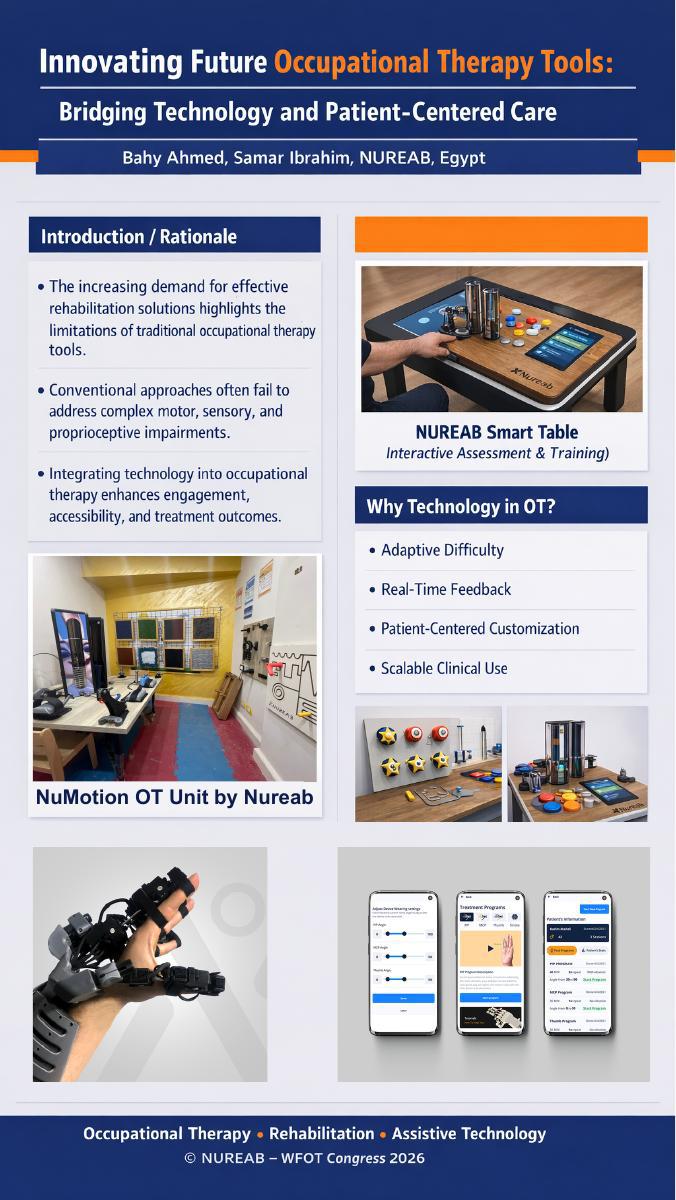
Introduction / Rationale:
The increasing demand for effective rehabilitation solutions calls for innovation in occupational therapy tools. Traditional approaches often fall short in addressing the complex needs of patients recovering from motor impairments. Integrating technology into rehabilitation can enhance outcomes and expand accessibility.
Objectives:
This presentation explores the development process of innovative occupational therapy (OT) tools, focusing on how technology-driven designs improve motor, sensory, and proprioceptive training. The goal is to demonstrate how patient-centered innovation leads to more effective and engaging rehabilitation.
Methods / Approach:
The development process involved collaboration with occupational therapists, engineers, and patients to ensure each tool meets specific rehabilitation needs. The approach combined biomechanical analysis, user feedback, and iterative prototyping to refine the design and functionality. Case studies from rehabilitation centers using NUREAB’s products illustrate real-world applications.
Results / Practice Implications:
NUREAB’s innovative OT kits and assistive tools have been implemented in rehabilitation programs across regions, benefiting over 50,000 patients. The integration of interactive and adaptive features has led to improved engagement and enhanced recovery rates. Results highlight the potential for technology to reshape occupational therapy by providing scalable, data-driven, customizable rehabilitation solutions.
Conclusion / Significance to the Occupational Therapy Profession:
The intersection of engineering and occupational therapy is driving a shift in rehabilitation. By leveraging technology to create accessible therapy tools, we can significantly improve patient outcomes. This presentation offers valuable insights into the innovation process, providing a framework for developing future OT tools aligned with evolving needs of the profession and its patients.