
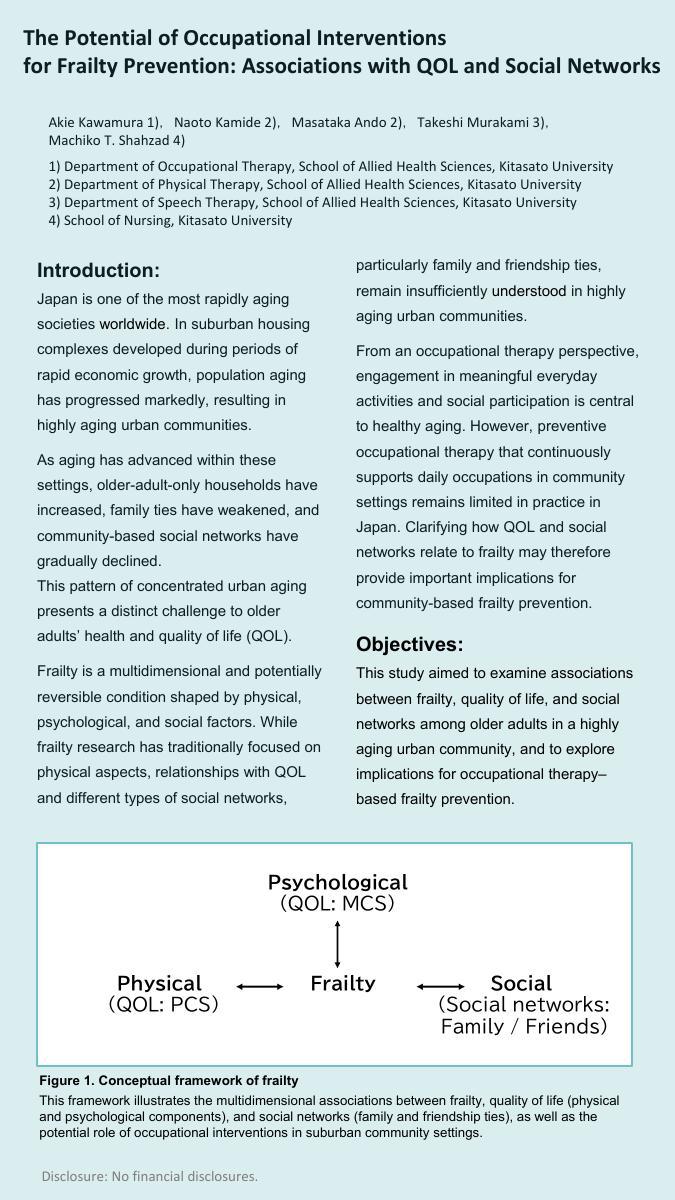
Introduction:Japan is a super-aging society, where declining social networks and increasing elderly-only households affect older adults' health. Frailty is a reversible condition influenced by physical, mental, and social factors. Preventing frailty is crucial, and maintaining QOL is central to frailty prevention.
Objectives: This study explores the associations between frailty, QOL, and social networks in a super-aging urban community and examines the potential of occupational interventions for frailty prevention.
Methods:A mail-based survey was conducted (2021–2024) targeting older adults (≥65 years) in a high-aging urban community (aging rate >50%).Data from 796 first-time respondents were analyzed. Frailty was assessed via Kihon Checklist (KCL).QOL was measured via SF-8 (PCS, MCS).Social networks were assessed via LSNS-6 (family/friend).Ordinal logistic regression examined frailty-related factors, and ROC analysis assessed predictive accuracy.
Results:Mean age: 77.37 years (SD = 6.60); 31.3% lived alone. Lower PCS (OR = 0.88, 95% CI: 0.86–0.90, p < 0.001) and MCS (OR = 0.87, 95% CI: 0.85–0.89, p < 0.001) increased frailty risk. Friendship networks (OR = 0.92, p < 0.001) correlated with lower frailty risk, while family networks (OR = 0.94, p = 0.028) had a weaker effect. ROC analysis showed an AUC of 0.587, indicating limited predictive accuracy.
Conclusion: Social network quality significantly impacts frailty risk. Friendship ties reduced frailty risk, emphasizing social connections. MCS had the strongest association with frailty, underscoring the need for holistic interventions. Occupational interventions fostering social connections and mental health may be key to frailty prevention. One urban area, AUC = 0.587 suggests limitations. Future research should refine predictive models by incorporating social participation, physical activity, cognition, and nutrition.