
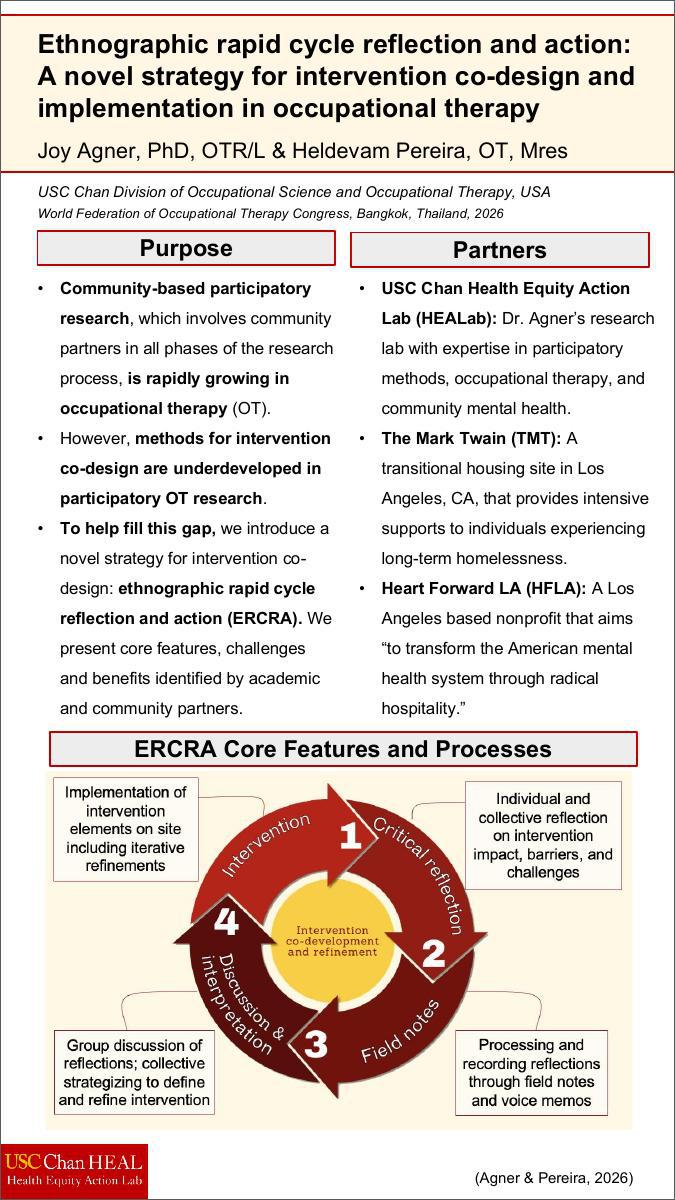
Introduction / Rationale: Community-based participatory research, which involves community partners in all phases of the research process, is rapidly growing in occupational therapy (OT). However, methods for intervention co-design are underdeveloped in participatory research. To help fill this gap, we introduce core features of a novel strategy for intervention co-design: ethnographic rapid cycle reflection (ERCR). In close partnership with a community-based nonprofit, residents, and staff, our team utilized ERCR to develop an occupation-centered intervention focused on reducing loneliness and occupational deprivation in a transitional housing site.
Objectives: To articulate the process of ERCR for collaborative intervention development.
Methods / Approach: The co-designed intervention utilized gardening, arts-based, and food-based activities to enhance purpose, power sharing, destigmatization, and meaningful relationships among people with serious mental illness who were formerly homeless. ERCR involves participant observation, ethnographic field notes and iterative reflective meetings to design, refine and implement the intervention in real-time. Challenges and benefits of this method were jointly identified using a critically reflexive process.
Results / Practice Implications: All stakeholders agreed that the use of ERCR supported real-time adjustments to the intervention activities, refinement of roles, and reconsideration of intervention components as new information was gathered in each session. Challenges of the intervention co-design included managing capacity, definition of roles, and navigating confidentiality.
Conclusion / Contribution to the occupational therapy profession: ERCR provides OTs and participatory researchers a structured framework for co-designing interventions, and thus advances strategies to engage community partners in novel intervention development.