
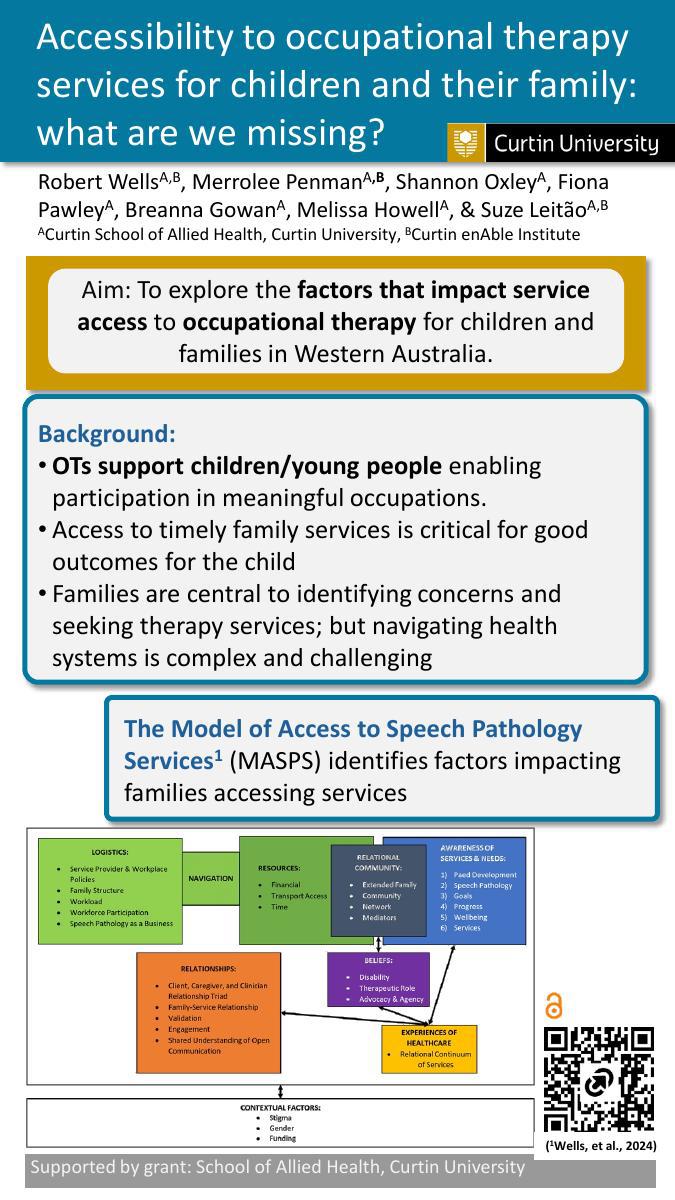
Introduction: Occupational therapists have a significant role in supporting children experiencing a developmental delay/disability and their families to participate in valued occupations, across contexts such as hospitals, clinics and schools. It is well recognised that family engagement is essential for effective intervention, therefore, service accessibility is crucial. Current accessibility research has primarily focused on specific populations or combined allied health services. Given occupational therapy's broad scope, understanding service access barriers for the wider populations is necessary. Recently, the Model of Access to Speech Pathology Services (MASPS) was published. This raised the question – was access to services profession-specific or could this be applied to other professions such as occupational therapy?
Objectives:
- What factors impact on family’s access to occupational therapy services?
- Are these factors also representative in the MASPS?
Methods: Six caregivers and six occupational therapists each participated in a semi-structured in-depth interview. Drawing from the MASPS, reflexive Thematic Analysis was used inductively and deductively to analyse the interview data.
Results: There was strong alignment of the factors identified for occupational therapy services for children in Western Australia to the eight MASPS categories of Logistics, Navigation, Resources, Relational Community, Beliefs, Awareness of Needs and Services, Relationships, and Experiences of Healthcare, as well as the additional Contextual factors.
Conclusion: Occupational therapy service more widely may find benefit in making use or the MASPS when considering how to design delivery of their services. Furthermore, similarities in factors impacting access to occupational therapy with other allied health professions can be investigated to develop a common allied health approach to relational health services.