
Introduction / Rationale: Refugees face challenges in their daily lives as a result of the complex nature of forced migration. Given that well-being, participation and perceived discrimination have a significant impact on refugees' occupational experiences, it is necessary to examine the occupational balance of refugees and the factors that shape it.
Objectives: This study aims to explore the relationship between occupational balance and well-being, participation and perceived discrimination, and the predictive effect of occupational balance on these factors in refugees.
Methods / Approach: A cross-sectional design was used with Syrian refugees aged 18-65. Participants were contacted by two different non-governmental organizations providing services to refugees between January-February 2025. Data were collected using the Demographic Information Form, Occupational Balance Questionnaire (OBQ11), Personal Well-Being Index-Adult (PWI-A), Participation Scale (PS), and Perceived Discrimination Scale (PDS).
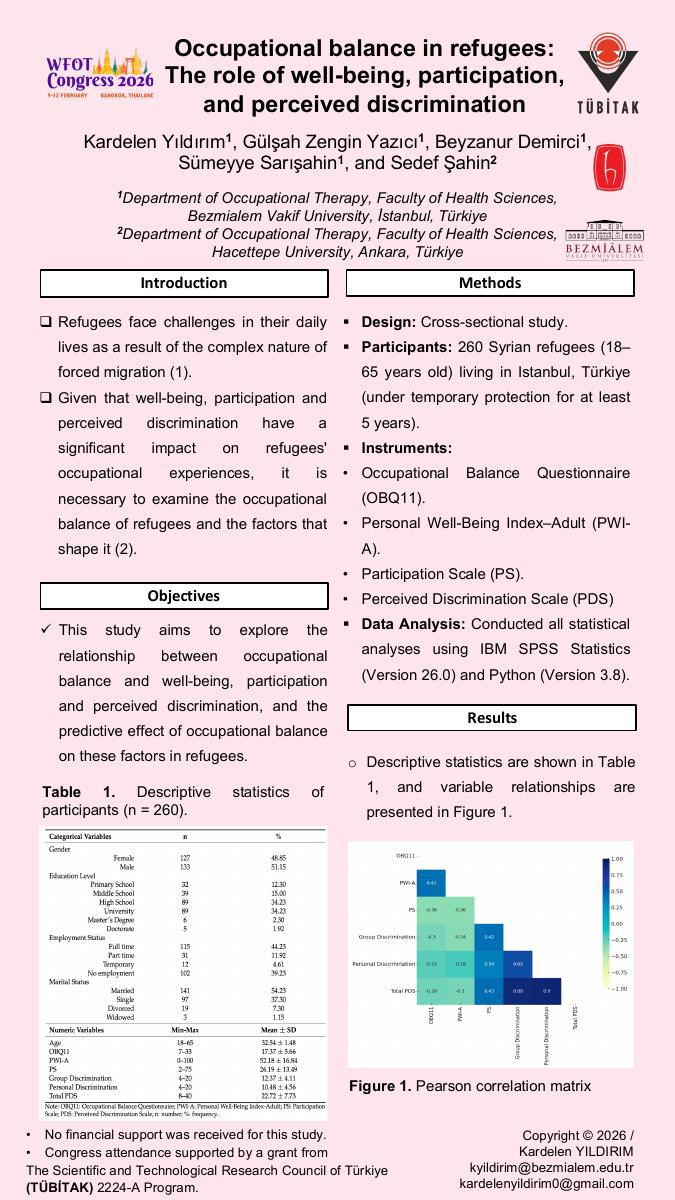
Results / Practice Implications: OBQ11 scores were significantly associated with PWI-A (p<0.001), PS (p<0.001), and PDS (p<0.001). The study's findings indicate that PWI-A (β=0.114, t=5.327, p<0.001) and PS (β= -0.107, t=0.026, p=0.002) have a significant predictor on occupational balance. In contrast, discrimination variables were found to have no impact (p>0.05).
Conclusion / Contribution to the occupational therapy profession: This study emphasizes the pivotal role of occupational balance in predictor refugees’ well-being, participation, and perceived discrimination, highlighting the need for meaningful daily activities to enhance their overall quality of life. The findings suggest that while occupational balance significantly supports social integration, its relationship with perceived discrimination is complex, indicating the presence of other protective factors. These insights highlight the need for community-based occupational therapy interventions that integration better health outcomes for forcibly displaced populations.