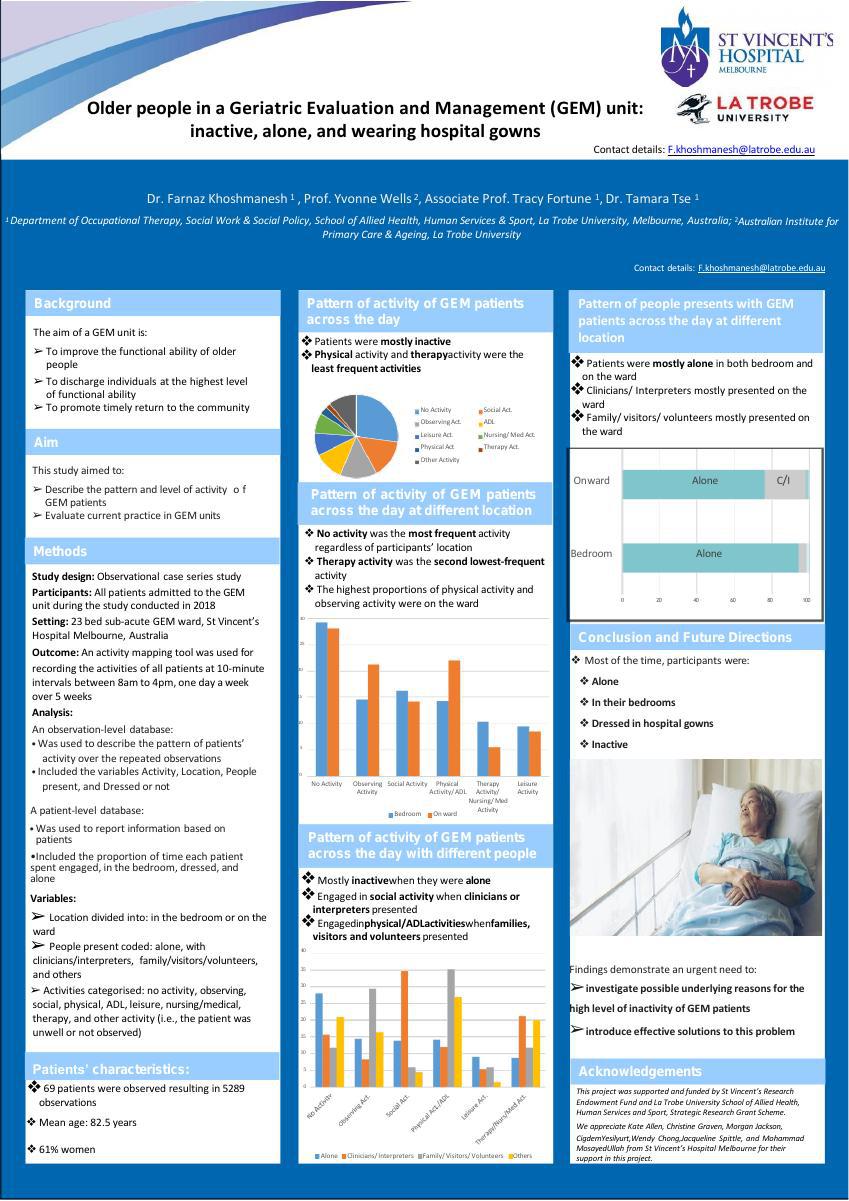
Introduction: Given the aim of GEM unit is to improve functional ability in routine daily activities of older people, discharging individuals at the highest level of functional ability is desirable. Achieving independence in the shortest possible time and enabling a timely return to the community provides a strong justification for measuring the level and patterns of activity of GEM patients during their stay in hospital and evaluating current geriatric rehabilitation practice.
Objectives: To investigate and describe how older patients admitted to a GEM unit spend their time.
Methods: The activities of all 69 patients admitted to the GEM unit of a tertiary metropolitan hospital were observed at 10-minute intervals for one weekday per week for five weeks (5,289 observations) in 2018.
Results: GEM patients were observed to be inactive for 27.2% of the observations (a higher proportion than for other types of activities), while 83.4% of the observed time was spent in the bedroom, 92.7% alone, and 86.4% in a hospital gown.
Conclusion: The results of this quantitative study indicate that GEM patients were spending most of their time inactive, in their bedroom, alone, and in their hospital gowns. Although the results of this study cannot be generalised to other GEM units, they provide a baseline for highlighting time use issues likely to be common in other GEM units. The findings of previous studies have highlighted the damaging consequences of low levels of older patients’ activity, which can lead to significant and irreversible functional decline, dependency on self-care activities, prolonged length of hospital stay, increased hospital readmissions, and early residential care admission of older patients.
