
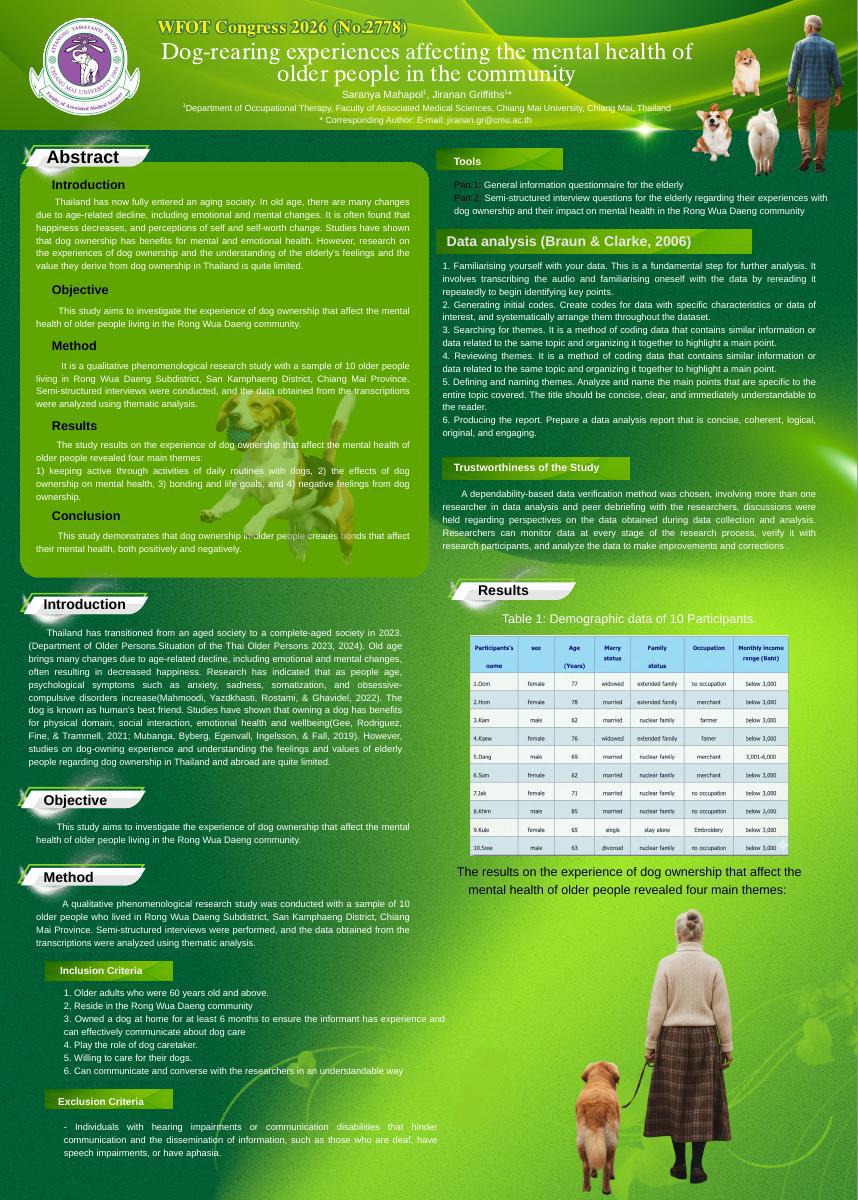
Introduction: Thailand has now fully entered an aging society. In old age, there are many changes due to age-related decline, including emotional and mental changes. It is often found that happiness decreases, and perceptions of self and self-worth change. Studies have shown that dog ownership has benefits for mental and emotional health. However, research on the experiences of dog ownership and the understanding of the elderly's feelings and the value they derive from dog ownership in Thailand is quite limited.
Objective: This study aims to investigate the experiences of dog ownership that affect the mental health of older people living in the Rong Wua Daeng community.
Method: It is a qualitative phenomenological research study with a sample of 10 older people living in Rong Wua Daeng Subdistrict, San Kamphaeng District, Chiang Mai Province. Semi-structured interviews were conducted, and the data obtained from the transcriptions were analyzed using thematic analysis.
Results: The study results on the experiences of dog ownership that affect the mental health of older people revealed four main themes: 1) keeping active through activities of daily routines with dogs, 2) the effects of dog ownership on mental health, 3) bonding and life goals, and 4) negative feelings from dog ownership.
Conclusion: This study demonstrates that dog ownership in older people creates bonds that affect their mental health, both positively and negatively.