
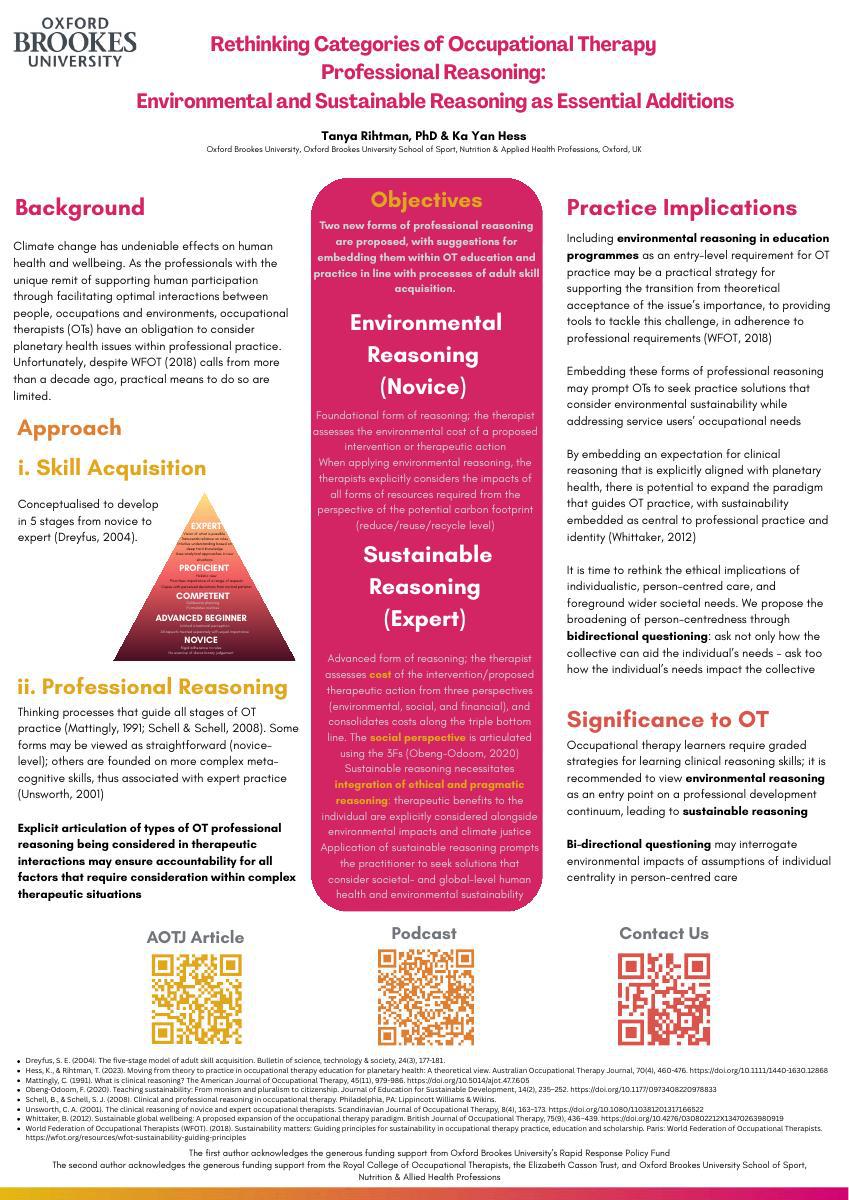
Rationale: Climate change has undeniable effects on human health and wellbeing. As the professionals with the unique remit of supporting human participation through facilitating optimal interactions between people, occupations and environments, occupational therapists (OTs) have an obligation to consider planetary health issues within professional practice. Unfortunately, despite WFOT calls from more than a decade ago, practical means to do so are limited.
Objectives: Two new forms of professional reasoning are proposed, with suggestions for embedding them within OT practice.
Approach: Professional reasoning refers to thinking processes that are used to guide all stages of OT practice, with various differentiated types identified. Some forms may be viewed as straightforward, novice-level, while others are associated with expert practice as they are founded on more complex meta-cognitive skills. The explicit articulation of the types of professional reasoning being considered in any interaction has the potential to ensure that OTs are accountable for all factors that require consideration within complexity therapeutic situations. The inclusion of ENVIRONMENTAL REASONING (novice) and SUSTAINABILITY REASONING (expert) as new categories of professional reasoning is proposed as a usable strategy for action on this essential issue.
Practice Implications: Embedding these forms of professional reasoning has the potential to prompt OTs to seek practice-led solutions that inherently consider societal- and global-level environmental sustainability while addressing the occupational needs of service users.
Significance to the Occupational Therapy Profession: The addition of these new categories of professional reasoning to OT practice may be a straightforward strategy for supporting the professional transition from theoretical acceptance of the need to consider environmental sustainability, to the provision of practical tools for tackling this challenge.