
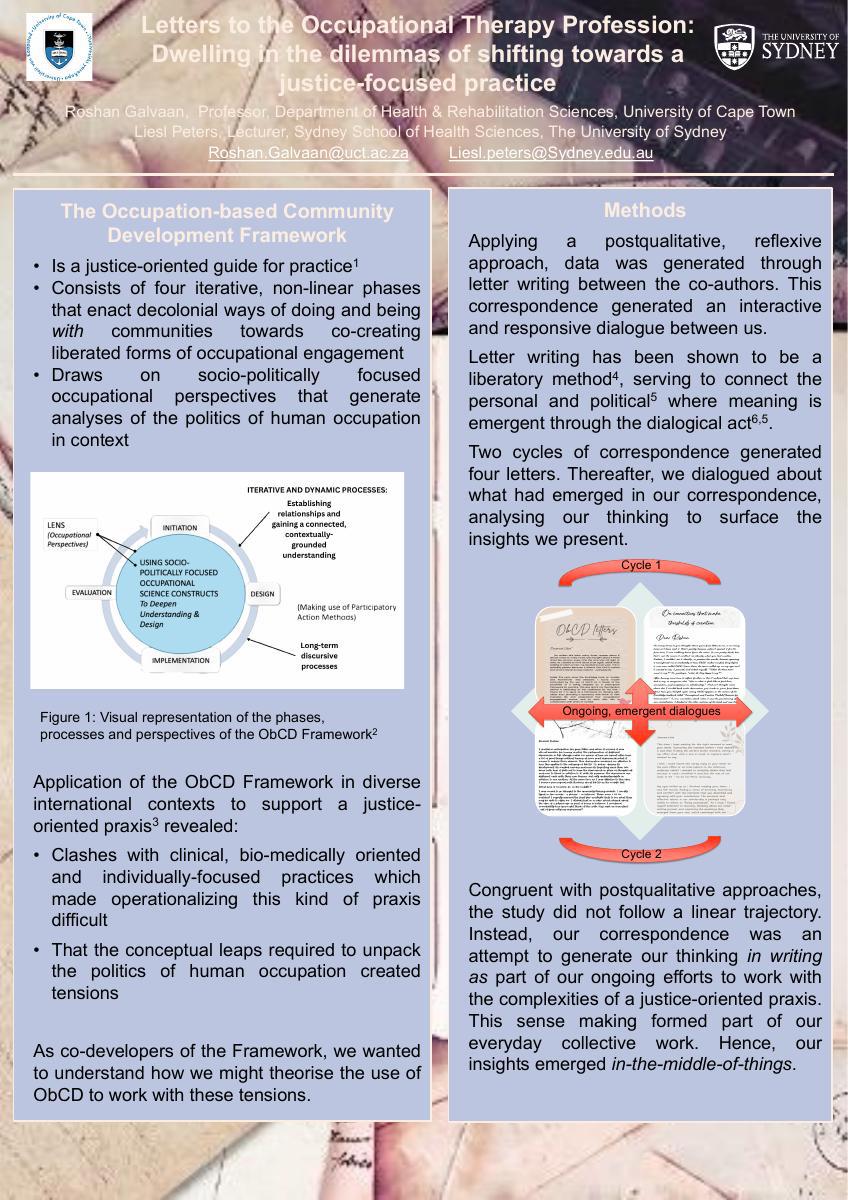
Background: The Occupation-based Community Development (ObCD) Framework is a justice-oriented guide for practitioners working in community settings. A qualitative descriptive study exploring how the ObCD framework was applied in teaching and practice internationally showed that, while it was instrumental in transforming education for community development practice, there were tensions in practice. This foregrounded the disjuncture between individualistically oriented practice models and practice applying complex socio-politically focused concepts informed by ObCD.
Objective: This poster sets out to actively work with the tensions arising from the disjuncture and describe the analysis of the authors’ reflexive accounts and recommendations in response to these.
Approach: As co-developers of the framework, the researchers employed a qualitative design, using letter writing, critical reflexivity, and dialogue. The authors engaged in three cycles of critically reflecting on the tensions and documenting them individually before engaging in dialogue with each other about them. The themes emerging from the dialogue were analysed to produce co-authored letters addressed to international occupational therapy educators and the practice community.
Practice Implications
Writing with decolonial love, the letters to the profession model and offer pathways towards justice-oriented praxis. These pathways include the work of navigating the complex social and political dynamics of working within systems that privilege individualistic modes of practice, ways of making space for shifting practice in occupational therapy and problem solving to demarcate and guide the use of ObCD to promote justice-oriented praxis.
Significance to the Occupational Therapy Profession
This poster provides educators and practitioners with insights into how to actively translate justice-oriented theories and concepts from occupational science into biomedical and individual-oriented practice contexts.