
Background: Sibling relationships are one of the most important but often overlooked family relations, impacting emotional growth, social interactions, and overall health. Yet these sibling relationships can be influenced in unique ways by factors including the type of disability, family composition and socio-economic background when one of them has a disability. The siblings of children with disabilities face a unique mix of challenges and emotional complexities that can affect their relationship.
Aim: The aim of this study is to identify the relationships between siblings and their siblings with a disability.
Methods: The study followed a cross-sectional quantitative study design. Data was collected through a face-to-face survey among 305 participants including siblings and their sibling with a disability and Biographical Information Scale (BIS). Participants were recruited from Occupational Therapy indoor, outdoor, different therapy center, rehabilitation centers, and special schools around Bangladesh.
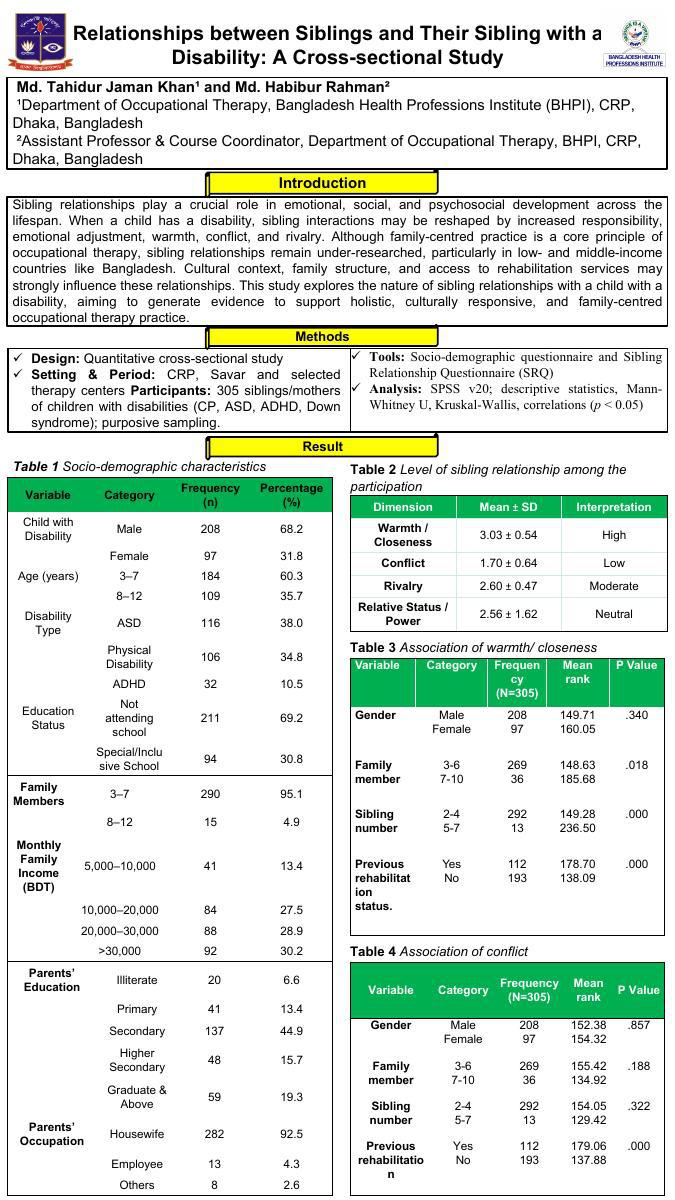
Results: The socio-economic characteristics and sibling relationships of children with disabilities. A study on gender, age, family size, disability, education, etc. Results: The findings showed that most of the participants were a male (68.1%), aged between 3–7 years (60.3%), with autism spectrum disorder (38.0%) being the most prevalent disability. Overall, sibling relationships tended to be positive, with high scores on warmth/closeness (M=3.03 ±. 540), and low (M=1.70 ±. 641).
Conclusion: Age, disability type and educational environment made the most difference to sibling relationships, with caregiver education and parent occupation seemingly less influential, the study found. Long-term effects for educational hospital and formulation of caregiver’s education and rehabilitation should be further addressed in future research to improve sibling progress
Keywords: Sibling Relationship, Occupational Therapy, Disability