
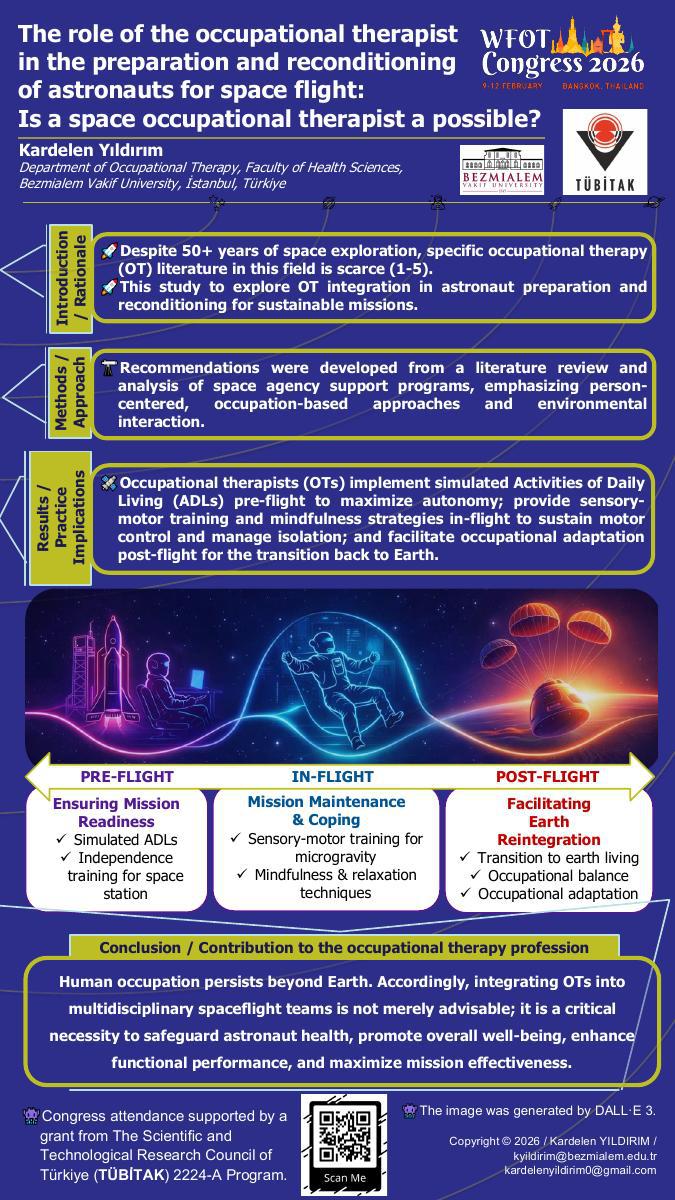
Introduction / Rationale: Occupational therapists work across diverse age groups and diagnoses, and the academic literature reflects a broad range of disciplines, including philosophy, sociology, psychology, engineering, neuroscience, and ecology. However, it is noticeable that there are few studies expressed, discussed or conducted by occupational therapists on space missions, which has been a global field for more than 50 years. The effects of spaceflight and microgravity on astronauts are well-documented. Occupational therapists, with their expertise in human occupation and adaptation, can play a crucial role in ensuring sustainable space missions.
Objectives: This study explores the integration of occupational therapy in astronaut preparation and reconditioning before, during, and after space missions.
Methods / Approach: A literature review and examining space agency astronaut support programs, recommendations for the integration of occupational therapists into space missions were developed that focus on person-centered, occupation-based, and environmental interaction.
Results / Practice Implications: Occupational therapists can be involved in a variety of space missions, including simulated daily living activities to increase astronauts' independence on the space station, sensory-motor training to provide motor control in the microgravity of space, mindfulness techniques and relaxation exercises to cope with prolonged isolation, and activity-role balance adaptation for the transition back to Earth.
Conclusion / Contribution to the occupational therapy profession: Occupational therapy has been identified as a discipline with potential for application on Earth and in extreme environments such as space. It is recommended that occupational therapists collaborate with space agencies in order to become part of multidisciplinary support teams. The objective of this collaboration to ensure the optimal health of astronauts and enhance the efficiency of mission.