
Introduction: The present proposal was developed as a postdoctoral internship which constitutes an extension of the implementation of a community outreach project carried out alongside the Occupational Therapy program at the Baixada Santista campus of the Federal University of São Paulo (Unifesp) and serves as an opportunity to deepen the analysis of questions that emerged during this process. The analysis of data collected through field research was conducted in collaboration with researchers from CIES/ISCTE- University Institute of Lisbon (Portugal).The research begins with a critical analysis of urban revitalization policies and the impacts of these interventions on the daily lives of residents.
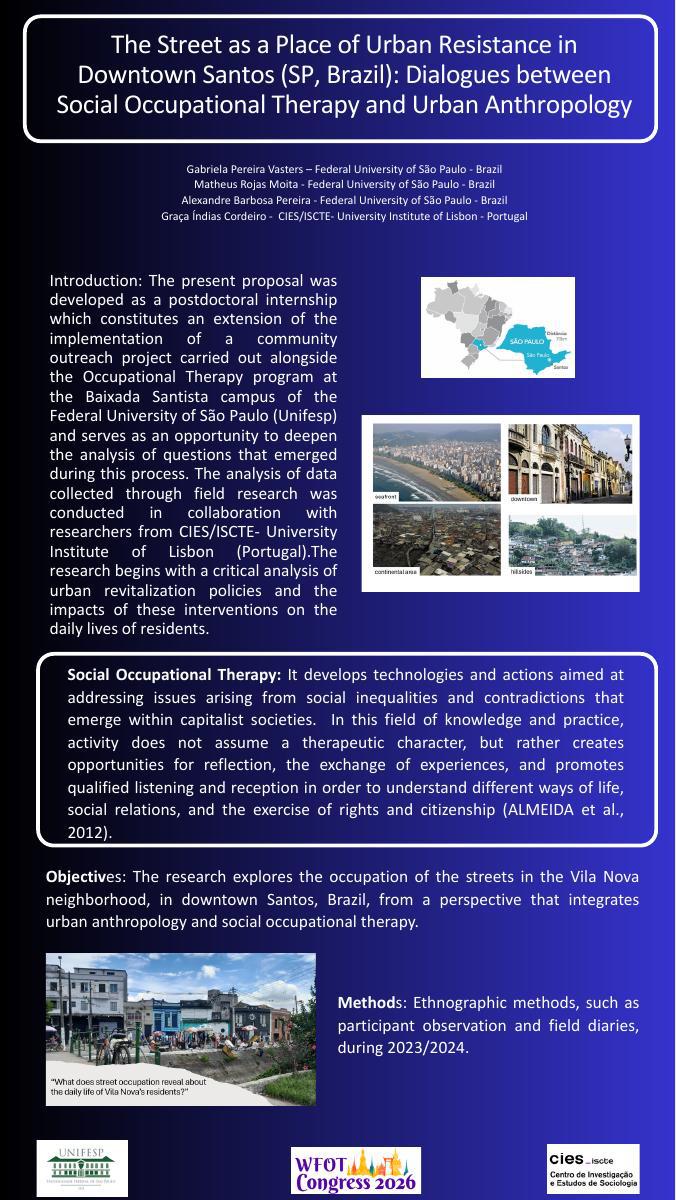
Objectives: The research explores the occupation of the streets in the Vila Nova neighborhood, in downtown Santos, Brazil, from a perspective that integrates urban anthropology and social occupational therapy.
Methods: Ethnographic methods, such as participant observation and field diaries, during 2023/2024.
Results: The study reveals the dynamics of sociability and resistance in public space, ranging from the use of the street as a recreational space to practices of informal economy. The work addresses how different groups – children, youth, adults, and the elderly – appropriate the streets, creating networks of solidarity and forms of resistance against the violent actions of the state, insufficient public policies, and gentrification. The research emphasizes the importance for Occupational Therapy of understanding urban daily life not only as a space of conflict but also as a possibility for the creation and transformation of social reality.
Conclusion: By highlighting these dynamics, this research suggests that universities and community outreach programs can play an active role in building a more just and inclusive city.