
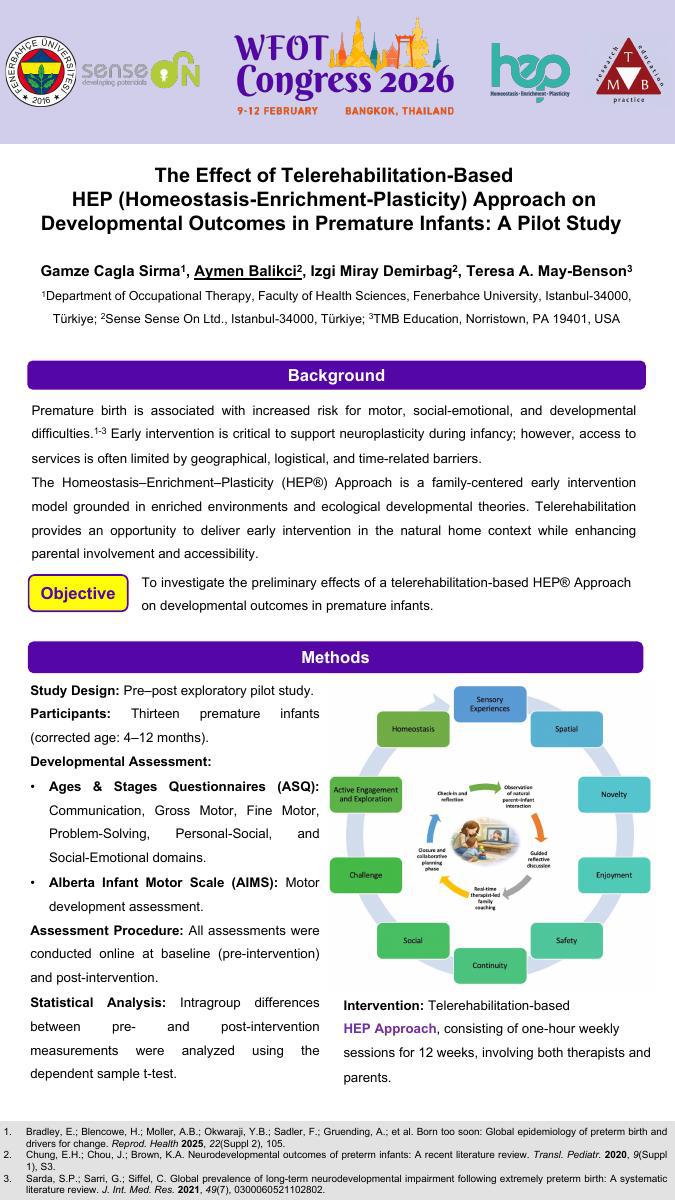
Introduction: Homeostasis-Enrichment-Plasticity (HEP) is an early intervention approach based on enriched environments and ecological development theories. Telerehabilitation offers a promising way to deliver early intervention to premature infants, improving accessibility and parental involvement.
Objectives: This study aimed to examine the preliminary effects of a telerehabilitation-based HEP approach on the developmental domains of premature infants.
Methods: Thirteen premature infants (corrected age: 4-12 months) were included. Sociodemographic information was recorded, and developmental skills were assessed using the Ages & Stages Questionnaires (ASQ) for communication, gross motor, fine motor, problem-solving, personal social, and social-emotional skills, and the Alberta Infant Motor Scale (AIMS) for motor skills. All assessments were conducted online before and after the intervention. The telerehabilitation-based HEP Approach consisted of one-hour weekly sessions for 12 weeks, involving therapists and parents. Intragroup differences between pre- and post-intervention measurements were analyzed using the dependent sample T-test.
Results: The mean corrected age of the infants was 8.03±1.56 months, and the mean gestational age was 31.23±2.45 weeks. Significant improvements were found in AIMS (p<0.001), ASQ-Social Emotional (p<0.001), ASQ-Gross Motor (p=0.027), and ASQ-Personal Social (p=0.012) scores. No significant changes were observed in ASQ-Communication, ASQ-Fine Motor, or ASQ-Problem Solving (p>0.05).
Conclusion: The telerehabilitation-based HEP Approach supports gross motor, social-emotional, and personal social development in premature infants. The lack of significant change in other domains may be due to initial scores being above the cut-off value and natural developmental progress. HEP appears to be a feasible and accessible early intervention, but long-term randomized controlled trials are needed to confirm its effectiveness.