
Introduction: WHO Global Report on Assistive Technology (AT) promotes investment in sustainable provision. The AT2030 local systems strengthening project supports AT innovation ecosystems.
Objective: This paper describes a detailed interdisciplinary occupation focused, person-centred case study which provides locally co-designed bespoke prosthetic innovation, not readily available in Nepal.
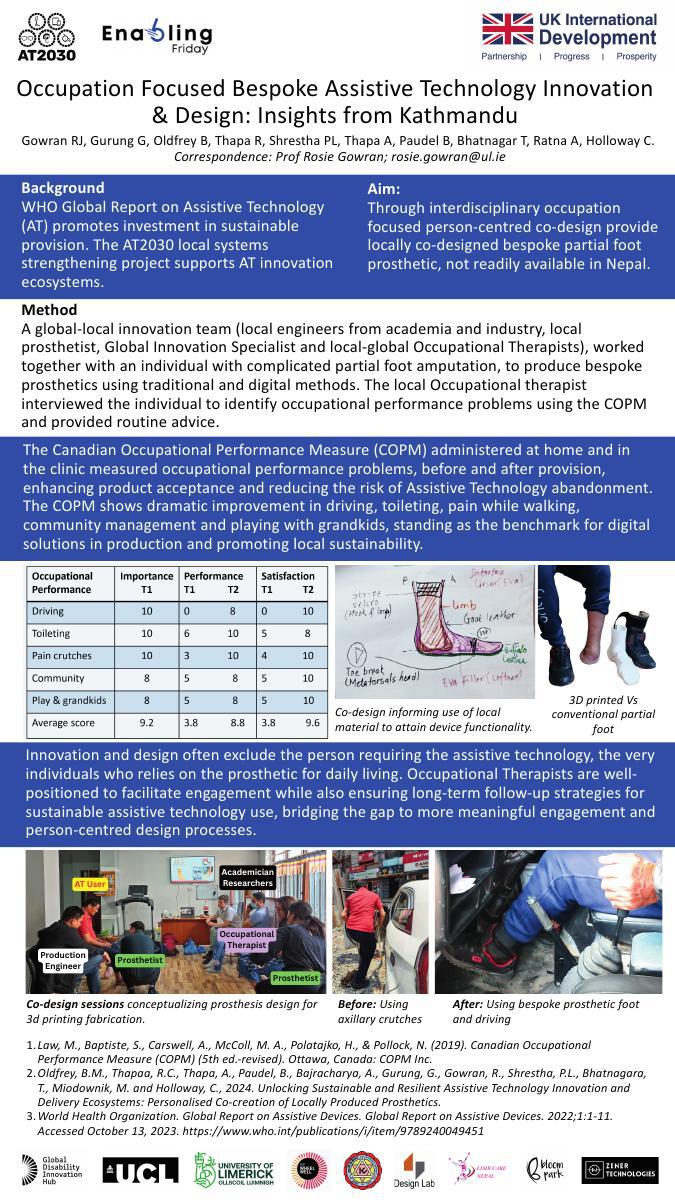
Approach: A global-local innovation team (local engineering from academia and industry, local prosthetist, Global AT Innovation Specialist and local-global Occupational Therapists), worked together with an individual with complicated partial foot amputation, to produce bespoke prosthetics using traditional and digital methods. The Person Environment Occupation and Performance model considered factors impacting daily living, livelihood and independence. The Occupational Therapists assisted co-design delivery, focusing on person-centred goals and desired outcomes. The Canadian Occupational Performance Measure (COPM) identified and measured occupational performance problems, before and after provision, enhancing product acceptance and reducing AT abandonment risk.
Results demonstrate successful co-design processes, improving daily living and quality of life, with significant change in COPM satisfaction scores from 9.6 to 3.8. following the provision of a traditionally produced prosthesis covered with Goat leather. Results show dramatic improvement in occupational performance (driving, toileting, pain while walking, community management and playing with grandkids), standing as the benchmark for digital solutions in production and promoting local sustainability.
Conclusion: Innovation and design often exclude AT users, the very individuals who rely on AT for daily living. Occupational Therapists are well-positioned to facilitate engagement while also ensuring long-term follow-up strategies for sustainable AT use, bridging the gap to more meaningful engagement and person-centred design processes.