
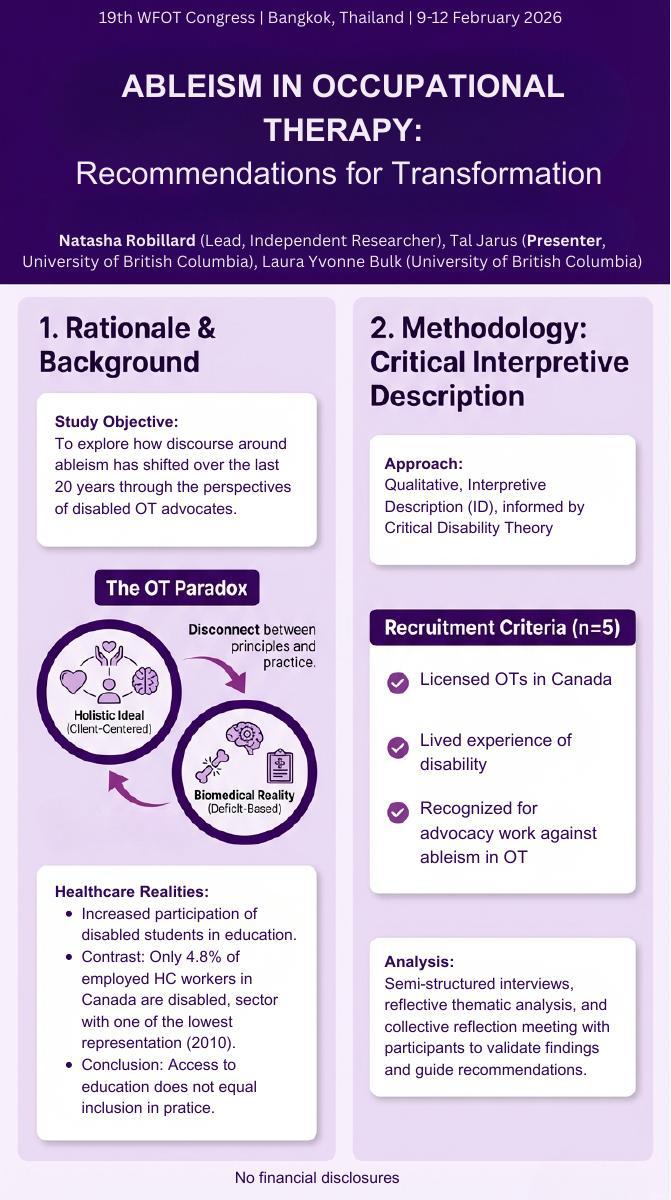
Rationale: Occupational therapy supports equitable participation in meaningful occupation for people who experience barriers. The profession is founded upon ableist notions of how people should engage in occupation and what occupations are acceptable for whom. While committed to providing collaborative relationship-focused care, occupational therapy remains shaped by ableist structures that influence practice, education, and professional identity.
This study elucidates Occupational Therapy’s evolving discourse around ableism, the barriers to reshaping this discourse, and key successes to inform change. Additionally, we will critically reflect on how change can be feasible considering the systemic, institutional, and cultural shifts required to translate insights into meaningful action within the profession.
Methods: This critical interpretive study conducted by disabled occupational therapists examines the perspectives of key leaders who have: (1) lived experience of disability, (2) professional experience as occupational therapists, and (3) demonstrated leadership in advocating against ableism. Data are collected through interviews about experiences of ableism throughout their careers, perceptions of shifts in discourse and practice, and insights into factors that have facilitated or hindered transformations. Following analysis, the researchers will hold a collective reflection with participants to revise findings and guide recommendations for change.
Results: We will share main themes and examine what it takes to move recommendations into practice—identifying tangible pathways for implementation, addressing potential barriers, and considering strategies for sustainable, systemic change.
Conclusion: We offer critical reflections and recommendations to advance conversations about ableism in OT, contributing to social change, holding the profession accountable, and moving toward disability justice.