
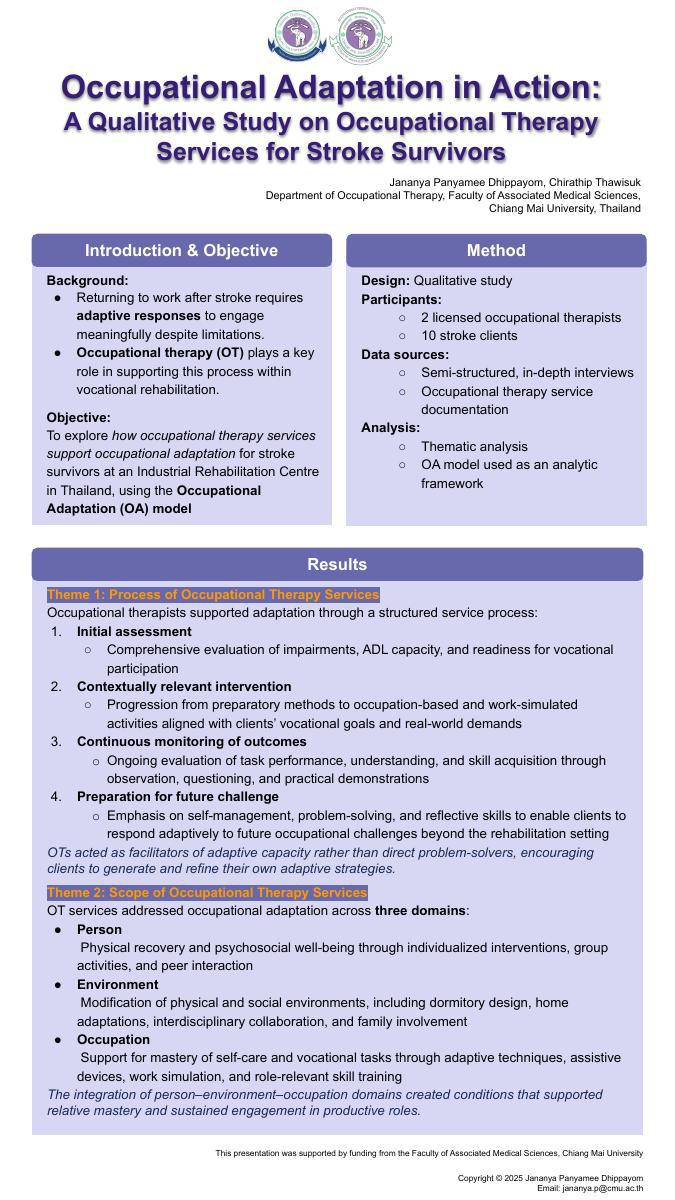
Introduction: Returning to work after a stroke requires individuals to develop adaptive responses that enable meaningful engagement despite functional limitations. Occupational therapy plays a crucial role in facilitating this process through comprehensive rehabilitation.
Objective : This study explored the provision of occupational therapy services for stroke clients at the Industrial Rehabilitation Centre in Thailand, using the Occupational Adaptation model as a framework.
Method: A qualitative approach was employed, involving the examination of health records from ten stroke patients. Additionally, in-depth, semi-structured interviews were conducted with two occupational therapists, complemented by a review of occupational therapy service records. Data were analyzed using thematic analysis.
Results: The findings highlight that occupational therapists support occupational adaptation through a structured service process, including initial assessment, contextually relevant interventions, continuous monitoring of rehabilitation progress, and preparation for future challenges. The services addressed key domains of person, environment, and occupation to enhance work reintegration.
Conclusion: This study provides insight into the occupational therapy service process that fosters occupational adaptation for stroke clients. However, further research exploring clients' perspectives and experiences is essential to gain a more comprehensive understanding of their adaptation journey.