
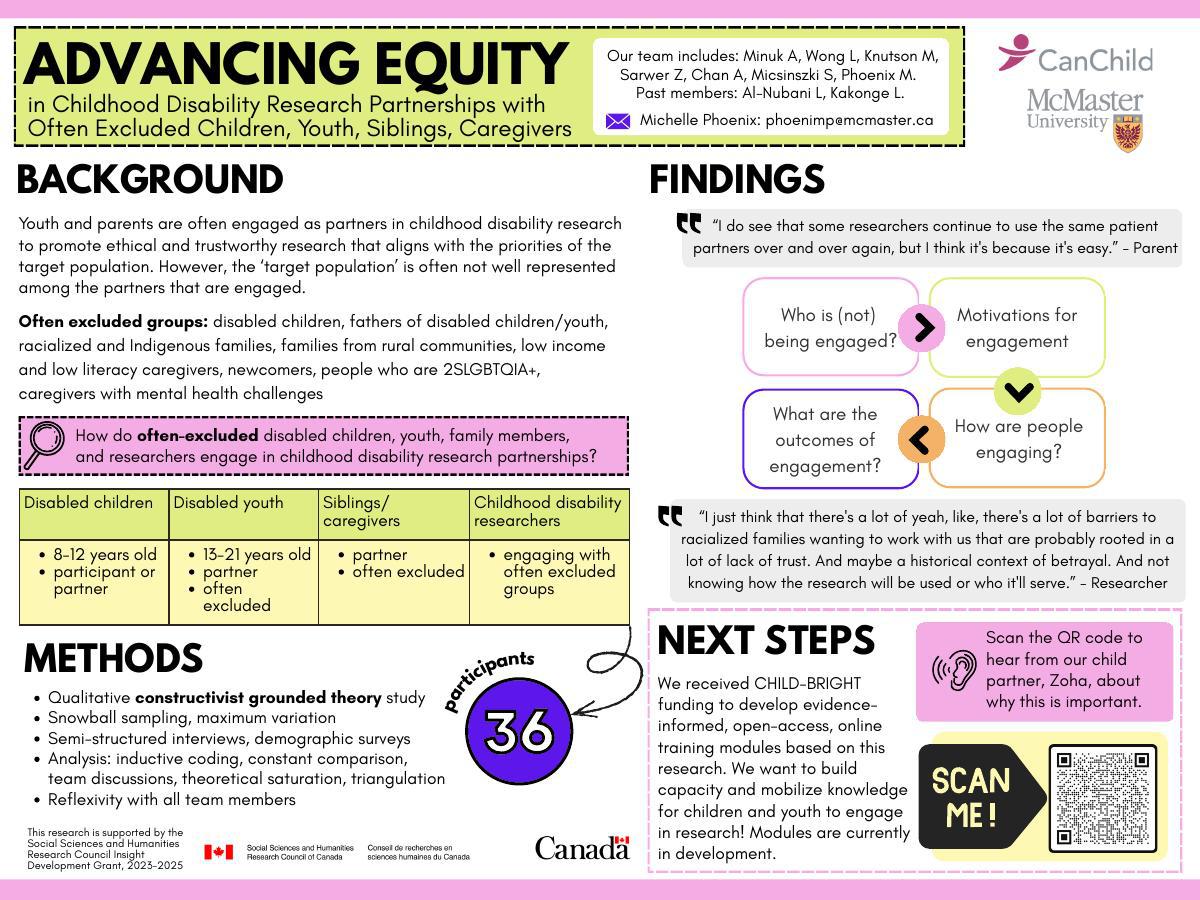
Introduction: People with lived/living experience are often included in research partnerships which is expected to increase the quality and uptake of the research. These partnerships may increase empowerment and build trust among children, caregivers, service providers, and researchers. However, people who are engaged in research tend to be privileged, such as mothers who have high income and education, are English speaking and have high literacy skills, are White and urban dwelling. Thus, their perspectives may perpetuate bias and reproduce inequity in the design, delivery, and evaluation of children’s rehabilitation services.
Objectives and Methods: We are conducting a qualitative grounded theory study to determine how disabled children, youth, siblings, and caregivers from often excluded groups can be engaged in childhood disability research.
Approach/Results: We conducted semi-structured interviews with 30 participants, including disabled children and people from often excluded groups who are siblings, youth, or caregivers (e.g., are racialized, fathers, live rurally, do not speak English, parents with disabilities) and the researchers who have engaged these partners. Constant comparison analysis was used, beginning with immersion in the data, inductively coding, and generating themes using memos and team discussion. Key findings include the power of motivation, principles of engagement (e.g., humanism, trust), the importance of communication and valuing peoples’ contributions. Reported impacts of the partnerships are described.
Practice Implications and Significance to the Occupational Therapy Profession: Research partnerships with people from marginalized populations may improve equity in occupational therapy services by: increasing diversity in participants, uncovering barriers to service use, and creating innovative services that are more likely to be implemented and achieve outcomes that are meaningful to the community.