
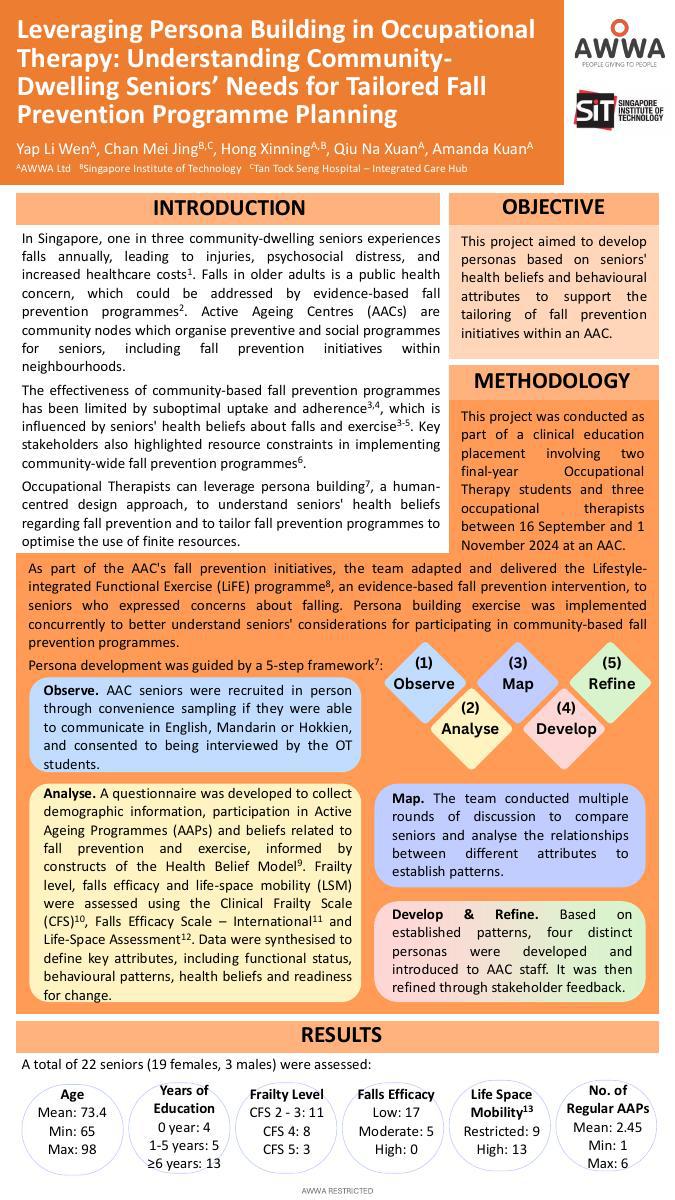
Introduction / Rationale: In Singapore, one in three community-dwelling seniors experience falls annually, leading to injuries, psychosocial distress, and increased healthcare costs. Despite the urgency of fall prevention, poor uptake and adherence limit the impact of existing programmes. Persona building, a human-centered design tool, enables Occupational Therapists to understand population needs and develop more targeted fall prevention strategies.
Objectives: This project aimed to develop personas to improve uptake and adherence to fall prevention initiatives among seniors at an Active Ageing Centre (AAC).
Methods / Approach: Three Occupational Therapists and two Occupational Therapy students used convenience sampling to recruit participants. Frailty level, falls efficacy and life-space mobility were assessed using the Clinical Frailty Scale, Falls Efficacy Scale – International and Life-Space Assessment. A project-designed survey captured qualitative data on health beliefs and participation in active ageing programmes. Findings informed persona development, refined with AAC staff insights.
Results / Practice Implications: A total of 22 seniors (aged 65 to 98) participated in the project, resulting in four personas: (1) Proactive Priya, (2) Open Osman, (3) Hesitant Hoon, and (4) Withdrawn William. These personas captured key health beliefs, behaviours, and environmental influences. Additionally, they served as a tool for AAC staff to evaluate on strengths and gaps in their existing active ageing programmes, particularly for fall prevention. Staff reported that the personas accurately represented their senior population and provided valuable insights for programme improvement.
Conclusion / Contribution to the occupational therapy: Occupational Therapists can enhance population health by using data-driven insights to understand seniors' needs, guiding the design of more targeted fall prevention strategies in community settings.