
Introduction/Rationale: Sensory processing (SP) allows children to register/modulate/organize sensory input, essential for development. Impairments in SP can lead to Sensory Processing Disorder (SPD) which impacts learning, affecting 5–16.5% of children. Socioeconomic status (SES) is critical in shaping children's sensory environments, but research on the SES-SP relationship remains limited.
Objective: To examine the relationship between SES and SP in children, incorporating electroencephalography (EEG) to assess neural correlates.
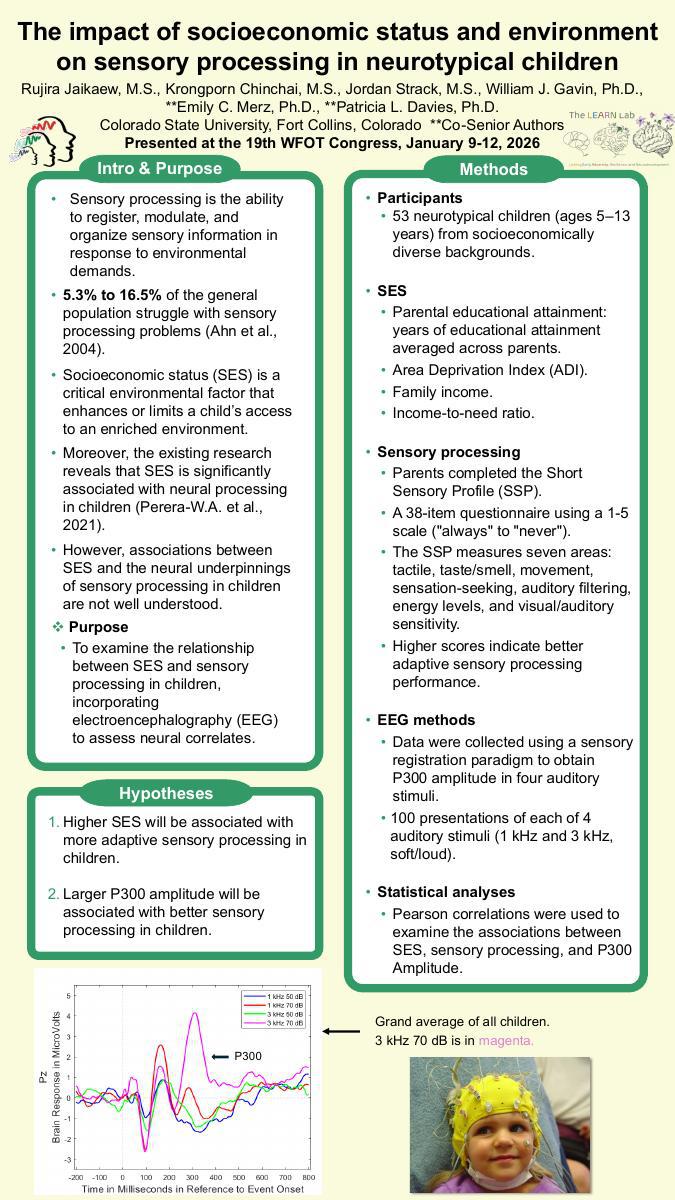
Methods: Participants included 53 neurotypical children aged 5–13. Parents completed the Short Sensory Profile (SSP). SES was measured using family income, parents' education, income-to-needs ratio, and Area Deprivation Index (ADI). EEG measured P300 amplitude using a sensory registration paradigm which included four auditory stimuli.
Results/Practice Implications: Higher SSP scores correlated with parental education (r = 0.23, p = 0.048) and negatively with ADI (r = -0.23, p = 0.047), linking higher SES to better SP. Other SES factors showed no correlation. P300 amplitude, a cognitive processing measure, correlated with SSP scores (r = 0.31, p = 0.015), suggesting better SP enhances cognitive functioning. Higher education and lower deprivation correlate with fewer SP difficulties, likely from enriched environments. The P300-SP correlation indicates SSP is not merely subjective parental reports, but reflects actual neurophysiological differences in children's SP.
Conclusion/Significance to Occupational Therapy Profession: Findings highlight the need for targeted support for low-SES children to ameliorate deprived environments. Despite small correlations, likely due to school influence, future research should examine school-mediation effects. Understanding environmental impacts on SP can lead to innovative strategies for OT interventions.