
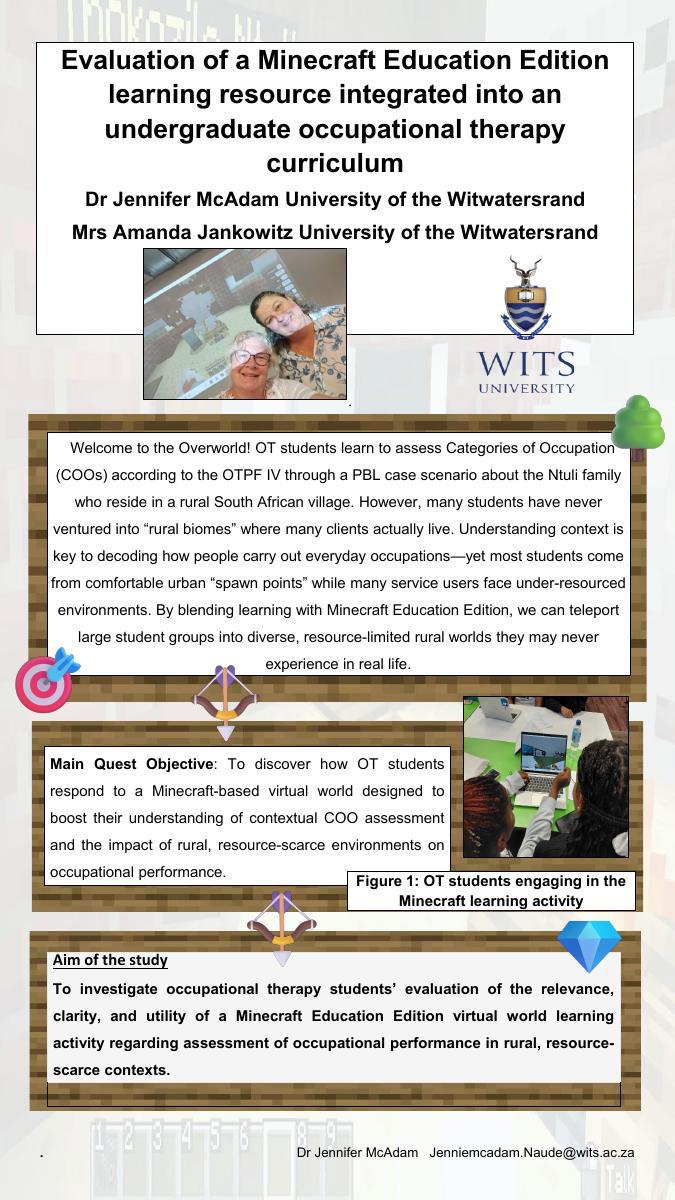
Introduction: Undergraduate occupational therapy students are taught contextual assessment of categories of occupation (COOs), yet few students have ever been exposed to rural contexts. Game-based learning can be a valuable resource to expose students to the occupational forms typical of rural settings.
Objectives: To determine the perceptions of occupational therapy students of a virtual world game e-learning resource developed to improve their understanding of contextual COO assessment and the impact of resource-scarce rural contexts on occupational performance.
Method: Design Based Research methodology was utilised. Micro-cycle 1 comprised analysis of challenges experienced by occupational therapy students when assessing COOs in unfamiliar rural settings. A Minecraft Education Edition (Minecraft E:E) virtual world depicting a rural village was created in micro-cycle 2 and information regarding contextual COO forms was presented to students using the newly developed virtual world. A descriptive, quantitative survey design followed in micro-cycle 3.
Results: Survey data were analysed using descriptive statistics. Preliminary results show that the Minecraft E:E learning activity has been a good resource for learning about contextual COO forms. The virtual world game enhanced enjoyment and made learning more interesting, despite numerous students having trouble in navigating the game.
Conclusion: The study contributes to the transformation of the occupational therapy curriculum and provides recommendations regarding a contextually relevant game-based learning resource which effectively conveys the impact of typical rural environments on occupational performance.
Key words: Digital game-based learning, occupational therapy, rural