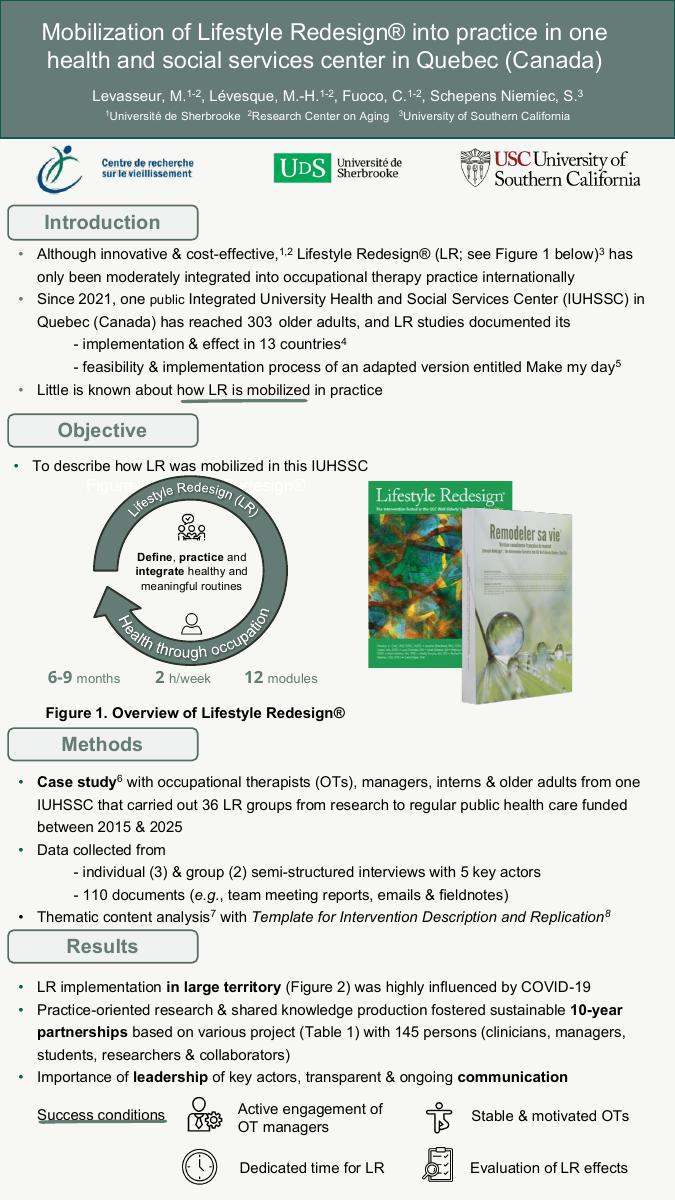
Introduction: Although innovative, cost-effective in supporting health, and available for implementation, Lifestyle Redesign® (LR) has only been moderately integrated into occupational therapy practice internationally. Since 2021, one public Health and Social Services Center (HSSC) in Quebec (Canada) has reached over 300 older adults, but little is known about how this institution implemented LR in practice.
Objectives: This study thus aimed to describe the implementation and sustainability of LR in one HSSC.
Methods: A case study was conducted with occupational therapists (OTs), managers, interns, and older adults from one HSSC. Individual and group semi-structured interviews, team meeting reports, email exchanges, and fieldnotes were subject to thematic content analysis.
Results: LR implementation and sustainability in practice were highly influenced by the COVID-19 pandemic and policies. From a research perspective, an approach serving the development of practices, as well as a process of shared knowledge production, facilitated a beneficial rapprochement with the HSSC. The mobilization and leadership of partners, expression of expectations, identification of a common goal, and shared understanding and decision-making ensured the necessary reciprocity for successful LR dissemination. According to practice, conditions for success were: active involvement of OT managers; stable presence of OTs who are passionate about LR; real and dynamic collaboration with researchers; dedicated time for preparation, strategic recruitment of participants; LR implementation (groups and individual sessions); and measurement and documentation of LR’s effects on participants and OTs.
Conclusion: By describing how LR has been implemented and sustained in one HSSC, these results inspire innovative changes toward preventive care.
