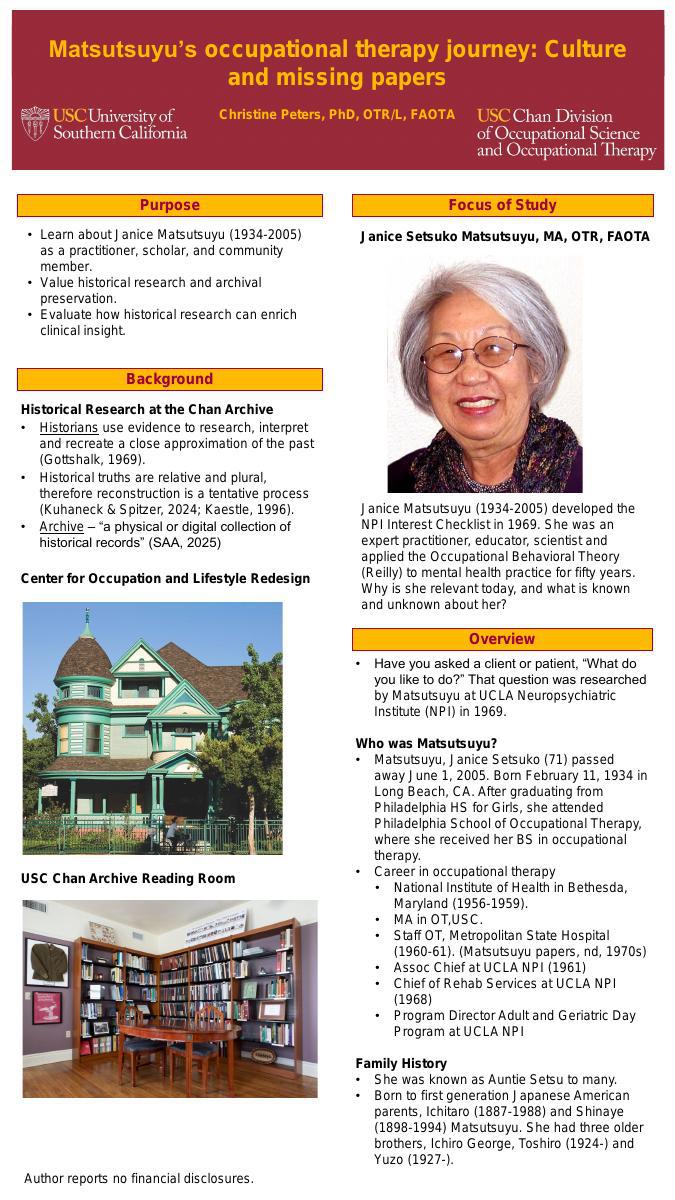
Introduction: Occupational therapists are exploring cultural competency, trauma, and care (Piller, 2022). Curiously, few discussions have revealed how one’s own culture influences a person’s path to occupational therapy (Kuhaneck & Spitzer, 2024). This historical study unfolds United States occupational therapist Janice Setsuko Matsutsuyu (1934-2005) sojourn, spanning 50 years of occupational therapy history from the early 1950s. She was internationally recognized as an administrator, researcher, educator, and mental health advocate. Author of The Interest Checklist (1969), an evaluation tool, she shifted the theoretical paradigm in mental health. This presentation addresses how practice and cultural heritage can interface.
Objectives: Attendees will learn how historical inquiry informs today’s practice, through a review of archival documents and problem solving. Attendees will be introduced to historical research methods, including question formation and seeking missing evidence.
Methods: The researcher reviewed source materials archived at a major University Archive, incuding published and unpublished papers, photographs, memorabilia. The outliers specific to World War II will be discussed, including missing papers, and steps taken to reconstruct a plausible lost past.
Results: Historical research uncovers past events internally in occupational therapy, and larger geopolitical and social influencers that shape practice.
Conclusion: This historical study explains how culture is a broader consideration in occupational therapy, specific to practice and the practitioners. Kuhaneck, H. & Spitzer, S. L. (2024) The issue iIs- The importance of conceptual origins. The case of the just right challenge. American Journal of Occupational Therapy, 78, 7804185110 http//doi.org/10.501/ajot,2024.050619 Matsutsuyu, J. S. (1969) Interest checklist. American Journal of Occupational Therapy, 23:4, 323. Piller, A, (2022) Defining trauma-informed care in OT. American Journal of Occupational Therapy, 76,
