
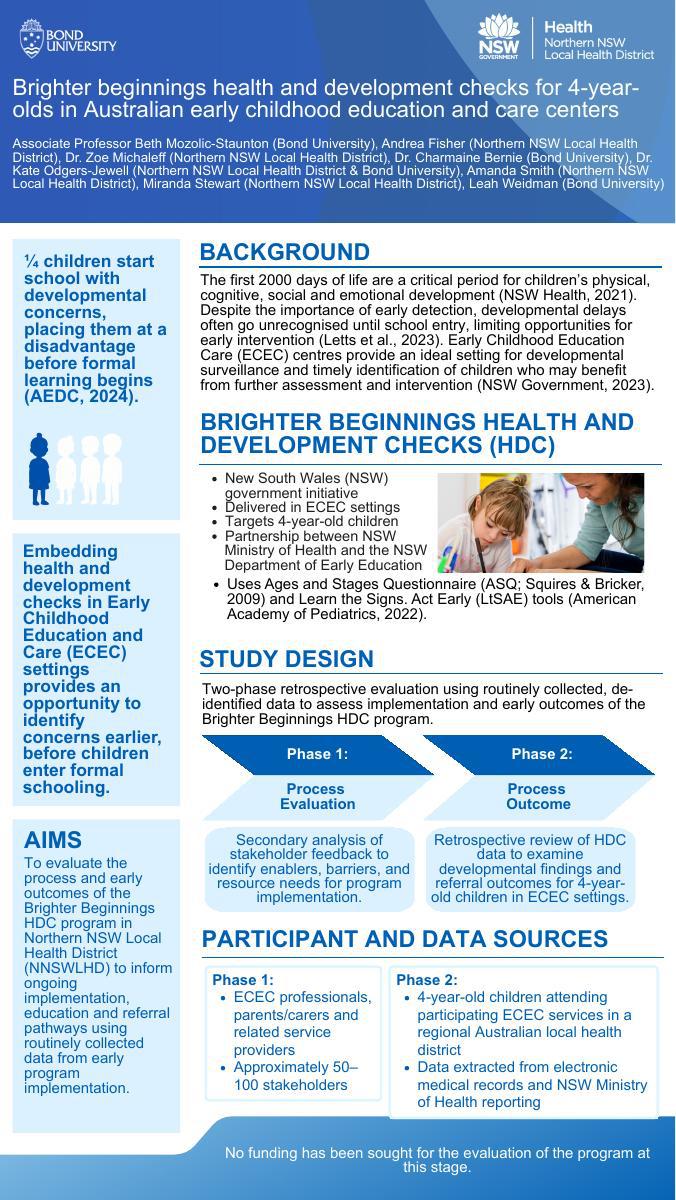
Introduction: Early identification of children displaying signs of developmental concerns is essential to providing appropriate interventions. Of Australian children, 22% have undetected developmental delays before starting school. The First 2000 Days framework emphasises the need for early identification of developmental delays in 4-year-olds to give them the best chance to succeed by improving school readiness, with occupational therapy playing a key role through early family-centred interventions.
Objectives: The aim is to evaluate the Brighter Beginnings program, a statewide collaboration between an Australian public health service and local early childhood education and care centers (ECEC) to apply an evidence-based process that integrates health and development checks in ECECs for monitoring and referring children with developmental vulnerabilities to appropriate local services for targeted early intervention.
Methods: Enablers, barriers and feasibility of the program implementation were explored via co-design and engagement with key stakeholders and reported via qualitative analysis of focus group data. The frequency, nature, and prevalence of developmental delays in 4-year-olds attending ECEC in a diverse rural Australian community were also reported based on retrospective clinical audit of the first cohort of health and development checks administered during 2025.
Results: Around 3,172 participants from 155 ECECs were invited to participate in this program. Preliminary findings show improved rates of early identification of developmental delays, leading to increased referrals to family-centred intervention services.
Conclusion: This research will guide the development of community-based early intervention services, including occupational therapy, and inform ongoing development of robust processes across health and education sectors to identify and support children with developmental vulnerabilities, improving long-term outcomes for children in rural Australian communities.