
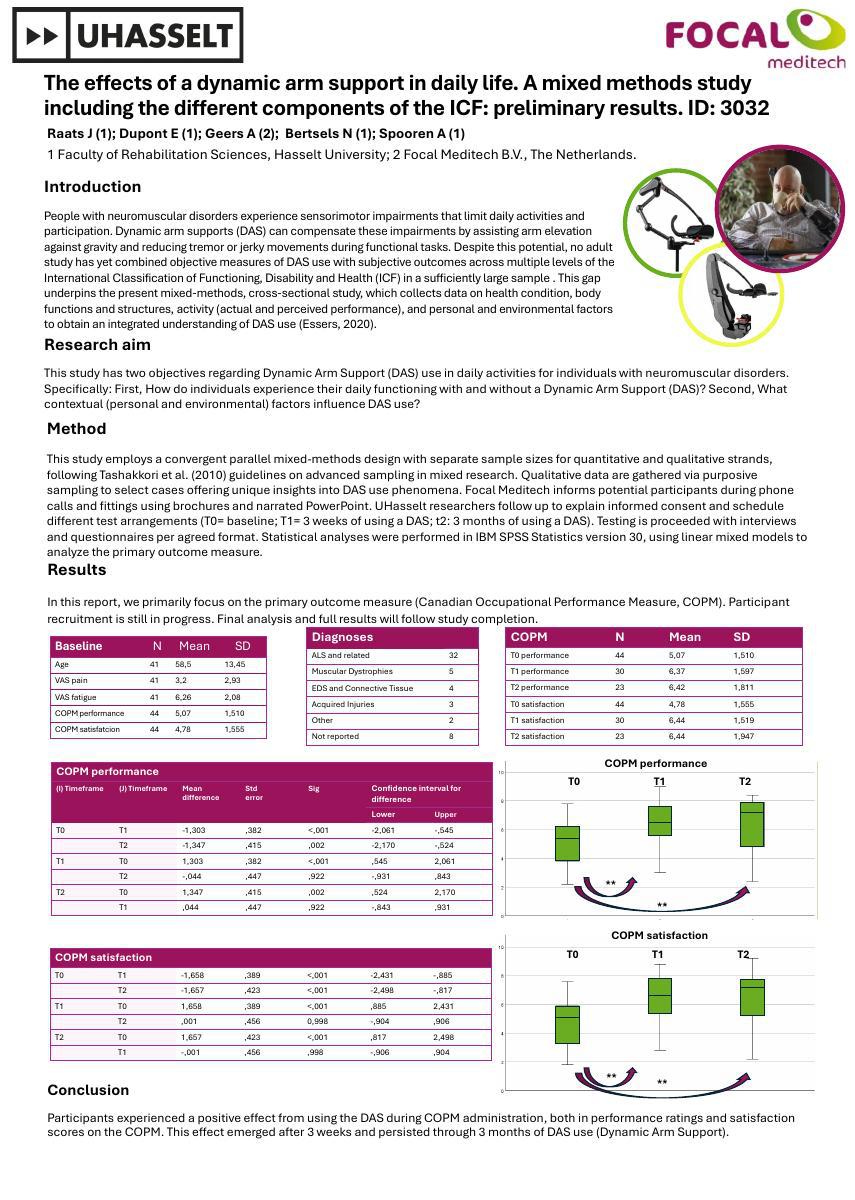
Introduction
People with neuro(muscular) disorders experience sensorimotor impairments that may result in limitations of their daily activities and restrictions in participation. To compensate for these impairments, a 'Dynamic Arm Support' (DAS) can be used. Currently, no study in adults links the objective use of a DAS to subjective measures across all levels of the ICF.
Objectives
To obtain in-depth insight into the effective use of DAS at different levels of the ICF, two research questions were established:
- How does a person experience their daily activities, with and without a DAS?
- What are the contextual (external and personal) factors that influence the use of a DAS?
Method
A convergent parallel mixed methods study. Interviews, questionnaires, and clinical tests are conducted to obtain information concerning the different components of the ICF at three time points (T0, T1, and T2; before, and 4/12 weeks after using the device).
Results
A total of 50 persons will be included. Currently, 30 persons have completed all three measurement points, and 20 persons are between T0 and T2. The first research question will be answered using various quantitative questionnaires, tests, and scales. Based on the results of the qualitative method, facilitators and barriers will be identified for the contextual factors in the use of a DAS.
Conclusion
The results at this stage will provide preliminary evidence of the efficacy of dynamic arm support in persons with neurological diseases in an integral manner.