
Introduction :
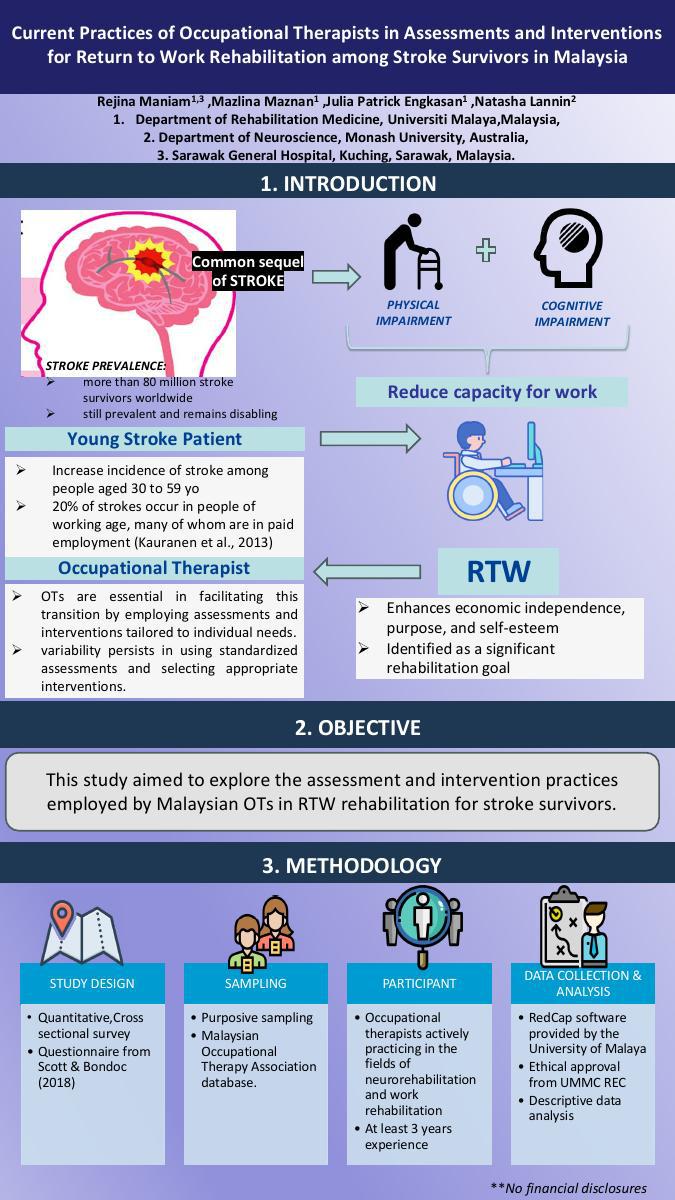
Return-to-work (RTW) after stroke significantly contributes to survivors' financial stability, social integration, and psychological well-being. Occupational therapists (OTs) are essential in facilitating this transition by employing assessments and interventions tailored to individual needs. However, variability persists in using standardized assessments and selecting appropriate interventions.
Objectives:
This study aimed to explore the assessment and intervention practices employed by Malaysian OTs in RTW rehabilitation for stroke survivors.
Methods :
A cross-sectional survey adapted from "Return to Work After Stroke: A Survey of Occupational Therapy Practice Patterns" (Scott & Bondoc, 2018) was conducted among 86 Malaysian OTs with at least three years of clinical experience in stroke and work rehabilitation. Participants were recruited using purposive sampling through the Malaysian Occupational Therapy Association's database. Data were collected online and analyzed using descriptive statistics in SPSS.
Results :
Findings indicated that Malaysian OTs frequently utilized both standardized and non-standardized assessments to evaluate physical (69.8%), cognitive (53.5%), and emotional/psychological (33.7%) work demands. Common assessments included Functional Capacity Evaluation (FCE), Montreal Cognitive Assessment (MoCA), Chessington Occupational Therapy Neurological Assessment Battery (COTNAB), and LAM Assessment of Employment Readiness (LASER). Regularly implemented interventions (>70%) focused on musculoskeletal rehabilitation, neuromuscular re-education, assistive technology training, and workplace modifications. However, standardized worksite and contextual assessments were infrequently used (<15%).
Conclusion :
The study highlights the active role Malaysian OTs play in diverse RTW interventions, yet underscores the need for greater consistency and standardization of assessments to enhance evidence-based practice and improve employment outcomes for stroke survivors.