
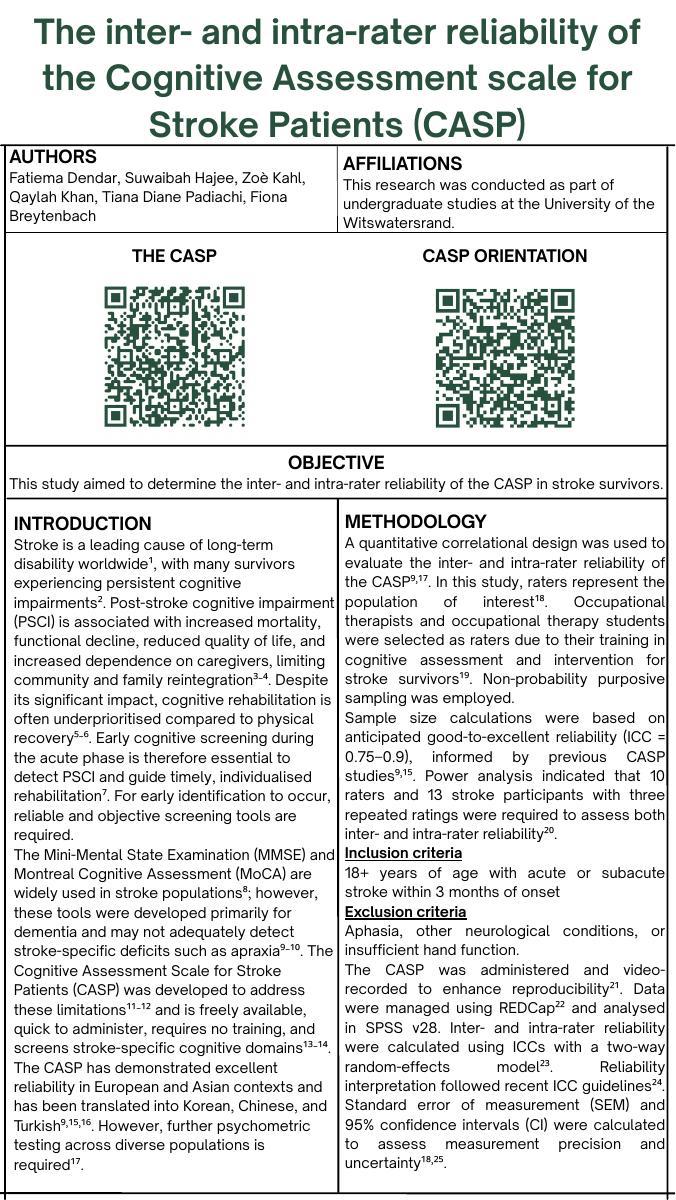
Introduction: Post-stroke cognitive impairments hinder stroke survivors' functioning and quality of life. Effective rehabilitation requires a cognitive screening tool that is designed to detect stroke-specific deficits, is free, requires no training and is reliable amongst novice therapists.
Objective: The aim of the study was to determine the inter- and intra-rater reliability of the Cognitive Assessment scale of Stroke Patients (CASP) in stroke survivors.
Methods: Eleven non-aphasic stroke participants were recruited from two hospital sites in Johannesburg, South Africa. The CASP was administered and video-recorded on stroke participants by one researcher. Ten novice occupational therapists and students constituted the raters. Each rater scored all stroke participants three times, each at two-week intervals. Inter- and intra-rater agreement was assessed using intraclass correlation coefficient (ICC).
Results: Inter-rater reliability was excellent (ICC>0.9) across the three trials ranging from 0.911 (95% CI: 0.822 – 0.970) to 0.931 (95% CI: 0.854-0.979). Intra-rater reliability was excellent for eight of ten raters (ICC>0.9), with the remaining two showing good agreement (ICC 0.75-0.9).
Conclusion: The CASP is a reliable tool for the cognitive screening of stroke survivors. Good-to-excellent inter- and intra-rater reliability found amongst novice raters shows the CASP’s suitability in environments with high client turnover and a young workforce.