
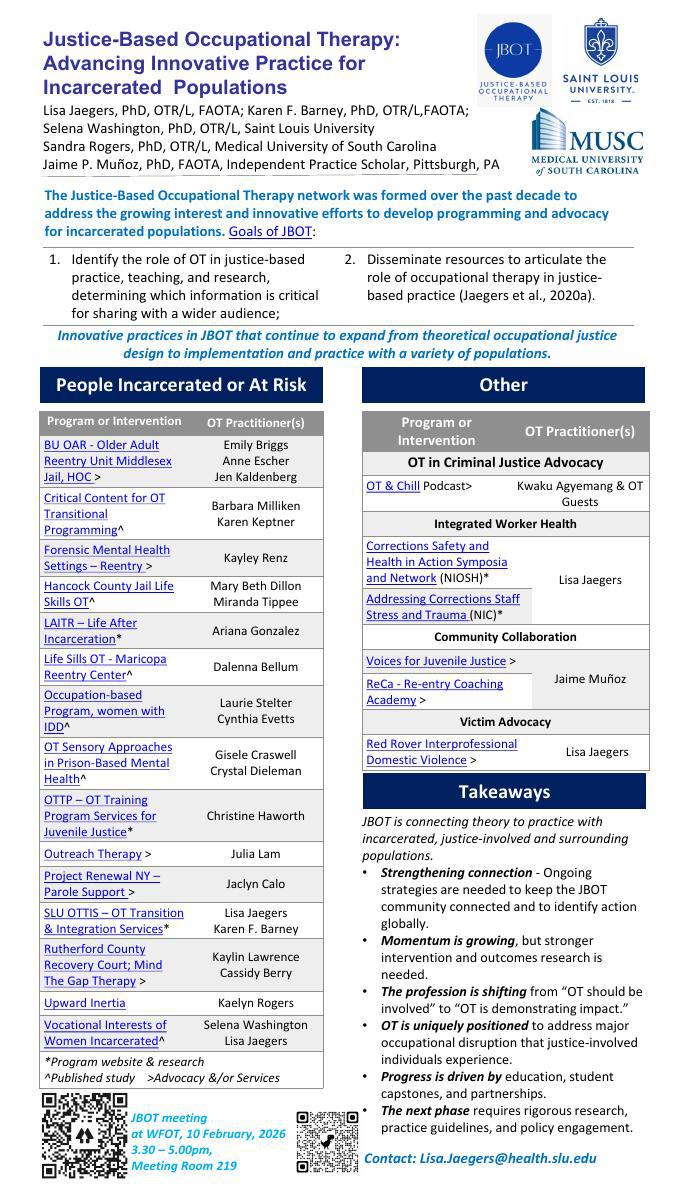
Introduction: The Justice-Based Occupational Therapy network was formed over the past decade to address the growing interest and innovative efforts to develop programming and advocacy for people typically underserved by OT.
Objectives: We will explore the goals of JBOT to (1) identify the role of occupational therapy in justice-based practice, teaching, and research, determining which information is critical for sharing with a wider audience; and (2) disseminate resources to articulate the role of occupational therapy in justice-based practice (Jaegers et al., 2020a). In early 2020, we identified four needed actions: advocacy/policy, education, resources, and research to advance occupational justice. In this session we will explore innovative practices in JBOT that continue to expand from theoretical occupational justice design to implementation and practice.
Approach: OT contributions to advocacy, policy and OT education are explored through a qualitative review of actions taken since 2020. Research and resources are explored from scoping review analysis with findings from OT in jail and prison settings, mobile health clinic development, programs for people unhoused, and a multitude of OT mental and behavioral health services in community settings.
Implications: Through the exploration or real-world examples of JBOT, we will demonstrate actions taken towards occupational justice in the larger community.
Contribution to the occupational therapy profession: Over the past decade, innovative justice related OT practice continues to grow in scale, creativity and collaboration. Through sharing our experiences, we can inspire further growth in justice based advocacy, education and programming for population health.