
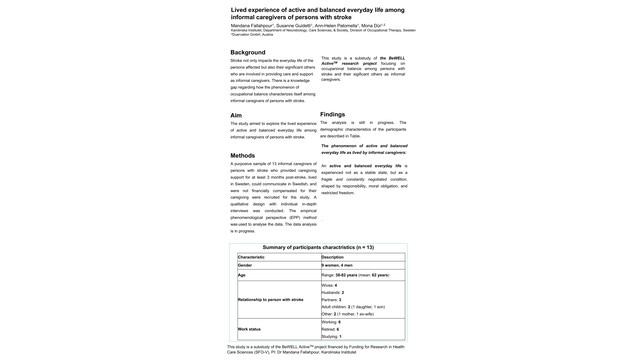
Introduction/Rationale: Stroke not only impacts the everyday life of the persons affected but also their significant others who are involved in providing care and support as informal caregivers. There is a knowledge gap regarding how the phenomenon of occupational balance characterizes itself among informal caregivers of persons with stroke.
Objectives: The study aimed to explore the lived experience of active and balanced everyday life among informal caregivers of persons with stroke.
Methods/Approach: A purposive sample of 12 informal caregivers of persons with stroke, who provided caregiving support at least 3 months post-stroke, lived in Sweden, could communicate in Swedish, and were not financially paid for their caregiving, were recruited in the study. A qualitative design with individual in-depth interviews was conducted. The empirical phenomenological perspective (EPP) method was used to analyze the data.
Results/Practice implications: The data analysis is in progress. The data analysis revealed a dramatic change in participants’ everyday life due to their caregiving tasks. The findings will be presented as themes to characterize the lived experiences of the participants.
Conclusion: The study findings contribute to addressing the occupational needs in the target group and how it impacts their health and well-being; moreover, the findings contribute to developing an innovative health-promoting intervention program based on the needs and priorities of informal caregivers of persons with stroke.