
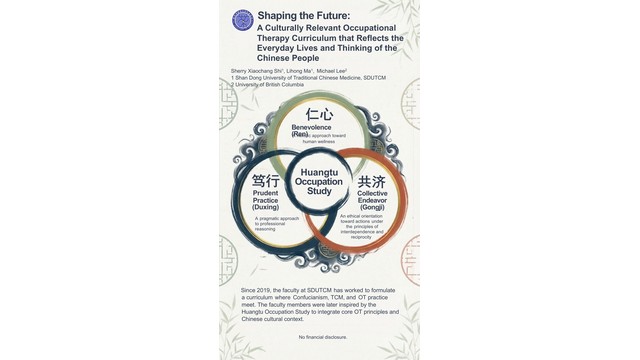
Introduction: China has been a full WFOT member since 2018, with over ten accredited Bachelor-level Occupational Therapy (BOT) programs. However, the core content, including professional reasoning, of these programs originated from the Western models and does not consider Chinese cultural contexts. To advance the Occupational Therapy (OT) profession in China, it is essential to develop a curriculum that reflects the daily lives and thinking of the Chinese people.
Objectives: Deep dive into the Chinese culture and ways of thinking, we developed a culturally relevant BOT curriculum. This presentation shares our curriculum development journey.
Method: We formed a curriculum committee to identify areas for improvement of our existing curriculum. Literature on Chinese ways of thinking was reviewed, and these concepts were integrated into developing the new curriculum. We examined relevant documents, including educational theories and other OT curriculum frameworks. A series of workshops were conducted to assimilate learning into creating the new BOT curriculum vision, mission, and professional and educational frameworks.
Results: The new curriculum adopted the OT Huangtu Study as its professional framework and the Significant Learning as its educational framework. We identified the intersections of the two frameworks to redevelop course contents and pedagogy. We are implementing curriculum evaluation to monitor the progress and the effectiveness of the new curriculum.
Significance: This initiative celebrates the first effort to create a BOT curriculum that reflects Chinese culture, highlighting the importance of contextualization. It may also serve as a blueprint for developing decolonialized OT curricula that foster cultural diversity.