
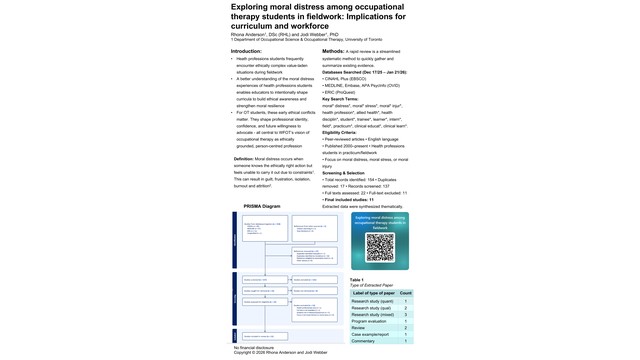
Introduction: Moral distress (MD) arises when an individual knows the right thing to do but is constrained from taking action. While studied in healthcare professionals (HP), MD among students remains underexplored. Unresolved MD may lead to compromised learning and, ultimately, negatively affect transition into the workforce. Cultivating moral resilience and fostering transformative learning could mitigate these effects, turning moral challenges into opportunities for growth and empowerment.
Objectives: This oral presentation will share occupational therapy (OT)-specific learnings from a larger HP study that explores two questions: Do university HP students from physiotherapy, OT , dietetics, speech-language pathology, and social work experience MD during fieldwork? What is the nature of morally and ethically challenging situations during fieldwork and how do they shape student learning?
Methods: The study employed a two-part, concurrent approach. First, a scoping review mapped the breadth of existing literature on MD among HP students, identifying gaps and guiding future research. Second, a convergent parallel mixed-methods study examined the student experiences. Quantitative data, collected through the Measure of Moral Distress-Healthcare Professionals, was integrated with qualitative insights from student-written reflections on morally and ethically challenging fieldwork experiences. Mezirow’s Theory of Transformative Learning will influence thematic data analysis.
Results: Results are pending; however, it is expected this study will advance the understanding of MD during OT fieldwork. Findings will inform curricula development by considering methods to catalyse transformative learning and moral resilience.
Conclusion: Strategies that support students’ ethical and professional growth are needed in our current healthcare climate. Through this study, we aim to enhance workforce preparedness and retention.