
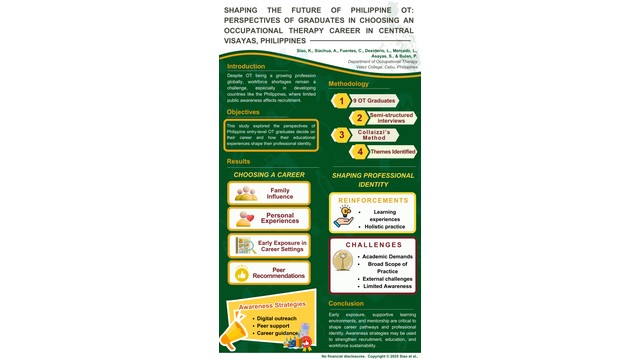
Introduction/Rationale: Occupational therapy (OT) remains in demand in the Philippines, yet student and practitioner shortages persist, possibly due to limited awareness.
Objectives: This study explored the perspectives of Philippine entry-level OT graduates in choosing OT as a career to improve awareness of OT and the current OT program.
Methods/Approach: Using a qualitative descriptive phenomenological approach, semi-structured interviews were conducted with nine (9) graduates from four locally accredited and two internationally accredited higher educational institutions offering entry-level OT programs. Colaizzi’s (1978) method ensured rigorous data analysis, with credibility strengthened through member checking.
Results/Practice implications: Key factors influencing the decision to pursue OT included family influence, personal experiences, career exploration, and peer recommendations. Participants were motivated by OT’s broad scope and fulfillment despite its challenges.
Opportunities in the entry-level OT program included rich clinical exposure, quality education, personal growth, and OT’s holistic scope. Potential constraints identified included high academic and fieldwork demands, a broad scope that requires significant cognitive load, challenges with online learning in a hands-on field, and limited public awareness.
Conclusion/Significance to the occupational therapy profession: The study provides insights into the current four-year entry-level OT program and offers recommendations to enhance OT awareness through social media, peer influence, outreach programs, and high school career guidance. Findings emphasize the need for institutional support to strengthen OT education and workforce development.