
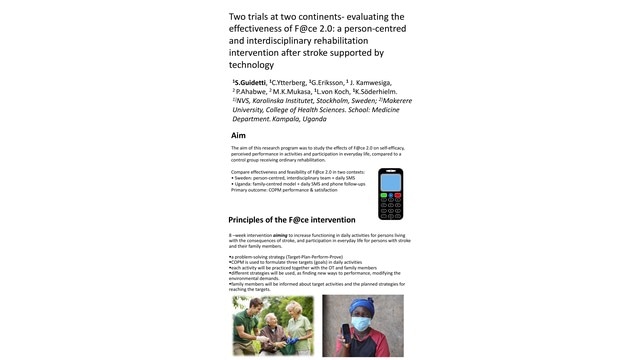
Introduction/Rationale: Stroke is a major non-communicable disease affecting over 10 million people globally each year. F@ce 2.0 is an activity based, person-centred intervention for stroke rehabilitation, combining digital support through mobile phones and in-person meetings with a rehabilitation team.
Objectives: The primary aim was to evaluate the effectiveness of rehabilitation after stroke with the intervention F@ce 2.0 regarding performance in and satisfaction with daily activities among stroke survivors.
Methods/Approach: Two hundred stroke survivors and 146 significant others are included in a pragmatic non-randomized controlled cluster trial (Sweden) and a randomised controlled trial (Uganda). Rehabilitation staff recruited intervention participants and delivered the F@ce 2.0 intervention and have been compared with controls as provided rehabilitation as usual. Primary outcome was perceived performance and satisfaction with daily activities.
Results/Practice implications: Both the intervention group and the control group in the respective countries improved significantly but there were no differences in outcome between them. A possible effect that needs to be further explored was that significant others in the intervention group showed a trend towards decreased caregiver burden.
Conclusion/Contribution to the occupational therapy profession: Person-centred rehabilitation supported by mobile phones and focusing on daily activities seems to be comparable to rehabilitation as usual for stroke survivors. The development and evaluation of F@ce 2.0 can thus be seen as part of an emerging transition towards the use of everyday technology to support person-centred rehabilitation after stroke in the home environment. This approach is crucial for occupational therapists and contribute to inspiring change and innovating futurein stroke rehabilitation.