
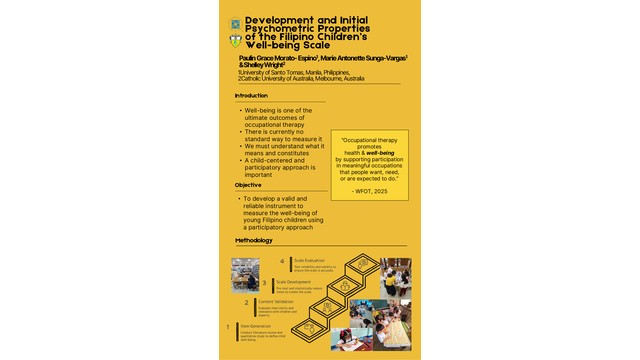
Introduction: The well-being of children is something that many individuals aspire to. In occupational therapy (OT), well-being is one of the ultimate goals of the therapeutic process, in addition to health and participation in life. However, there is currently no standard way to measure it. Also, to properly evaluate this outcome, we must first understand what it means and constitutes and, more importantly, take a child-centered and participatory approach.
Objective: This study aims to develop a valid and reliable instrument to measure the well-being of young Filipino children using a participatory approach.
Methods: We developed a measure of children’s well-being based on their perspectives and involving their active participation. Several steps were undertaken to achieve this, involving qualitative and quantitative methods. We reviewed the literature and determined the need to develop a new measure of well-being for young Filipino children. We then explored young Filipino children’s conceptualization of well-being to understand what makes them happy, which informed the item pool development. The new measure underwent content validation, both by the child and adult experts, and pre-testing before administering it to 288 children using an interview format.
Results: Exploratory factor analysis resulted in a unidimensional 12-item scale with an acceptable internal consistency. Initial psychometric testing demonstrates the new measure’s validity.
Conclusion: We developed a measure that occupational therapists can use to measure young children’s well-being. This will enable OTs to fulfill their role in helping clients, especially the younger ones and their families, achieve well-being.